



Uncertain favorites: Rory McIlroy, Scottie Scheffler start Masters with big questions
7 Min Read
Scottie Scheffler on Rory McIlroy's career Grand Slam
Players in Article
Players in This Article
Roughly 24 hours apart and within a few yards of where the other stood, Rory McIlroy and Scottie Scheffler pondered what the heck was going on.
McIlroy arrived at TPC Sawgrass’ back range late on the Wednesday afternoon before the start of THE PLAYERS Championship. It was his only time on the property ahead of a tournament he had grand ambitions to defend. At that moment, though, he was just trying to decide whether he could gut out a back injury and play. He would compete, but understandably struggled, narrowly making the cut and finishing on Sunday before the leaders had teed off.
Scheffler reached the back range on Thursday afternoon, shortly after an opening-round 72 that left a lot to be desired. His range session looked different. McIlroy took only 30 or so swings, many of them half shots to test his back. Scheffler, caddie Ted Scott and swing coach Randy Smith remained on the range for hours, enduring heavy rain as Scheffler tried to work through puzzling struggles that kept him from contention in recent weeks. He shot 73 the next day and finished outside the top 20.
Scottie Scheffler talks about golf’s ability to frustrate even the best players
The two favorites for this week’s Masters arrive with major questions. For McIlroy, it’s health. For Scheffler, it’s form. Neither has dealt with those respective concerns in a long time, and neither has competed since their quiet weeks at TPC Sawgrass, a course and tournament that have historically brought out their best. That’s an apt way to describe the duo’s relationship with Augusta National. They are the last two winners of the green jacket, built in a lab to win the Masters. Less than a month ago, they were overwhelming favorites to make it three in a row. Now? The expectations couldn’t be cloudier. Add in a pack of bona fide chasers that are rounding into form at the right time and the Masters is as wide open as it has ever been.
The question each player pondered at TPC Sawgrass is still relevant. What the heck is going on with Scheffler and McIlroy? And what impact will that have on their pursuit of another green jacket?
For Scheffler, the issue is his iron play – a sentence few expected would ever be written about the world No. 1. He led the PGA TOUR in approach play each of the last three seasons. In 2026, he ranks 80th. It’s more glaring than his off-the-tee performance, which has garnered headlines as Scheffler has switched between an older TaylorMade model and the latest version. What he will use off the tee this week is an open question. Yet he’s still been a top-10 driver of the ball this year despite that uncertainty.
The iron play is the bigger concern because it’s normally his superpower. It was the steadying force early in his career as he went through wild vacillations on the greens. It was the leading factor in his recent dominant run, as the rest of his game became elite, too. Even with one of the best putting seasons of his career so far, Scheffler isn’t elite without standout approach play. He’s still the top-ranked player in the world, but he’s not the overwhelming force that the rest of professional golf revolves around.
The decline hasn’t happened in just one area of his approach play. It extends from his wedges all the way to his long irons. In 2025, Scheffler ranked first in Approaches from > 100 yards. This year, he ranks 119th. In 2025, he ranked sixth in Approaches from > 200 yards. This year, he ranks 116th. Here’s a more complete comparison of the differing performance from key yardages between 2025 and 2026.
| Category | 2026 | 2025 |
| SG: Approach | 78th | 1st |
| Approaches from > 100 yards | 119th | 1st |
| Approaches from > 100 yards in rough | 142nd | 6th |
| Approaches from > 200 yards | 116th | 6th |
| Approaches from > 200 yards in rough | 149th | 2nd |
| Approaches from 100-125 yards | 96th | 2nd |
| Approaches from 125-150 yards | 123rd | 33rd |
| Approaches from 150-175 yards | 15th | 2nd |
| Approaches from 175-200 | 41st | 11th |
| Approaches inside 100 yards | 22nd | 4th |
He’s particularly struggling to keep the ball from overcutting, both off the tee and with his irons. When Scheffler is dialed in, he eliminates the right side of the golf course. His go-to cut shot is a tight left-to-right fade, piercing and sure. That is not the case this year. Last season, he ranked first in Right Rough Tendency (i.e., he found the right rough less than any player on the PGA TOUR). This year, he ranks 79th.
Scheffler has remained largely abstract when describing what he’s working on, careful not to give away too many secrets or leave the door open a crack for any speculation or scrutiny. That hasn’t stopped others from opining on what might be wrong.
“I don’t even recognize this golf swing from Scottie Scheffler,” Golf Channel analyst Brandel Chamblee said during a segment of Golf Channel's “Live From” at THE PLAYERS. “It’s a foot and a half shorter than it was last year and the face is wide open.”
“Generally, in my experience, when your swing gets shorter, it has to do with anxiety,” fellow analyst Paul McGinley responded. “You’re not free-flowing. You’re trying to poke it down there. You’re afraid to miss it.”
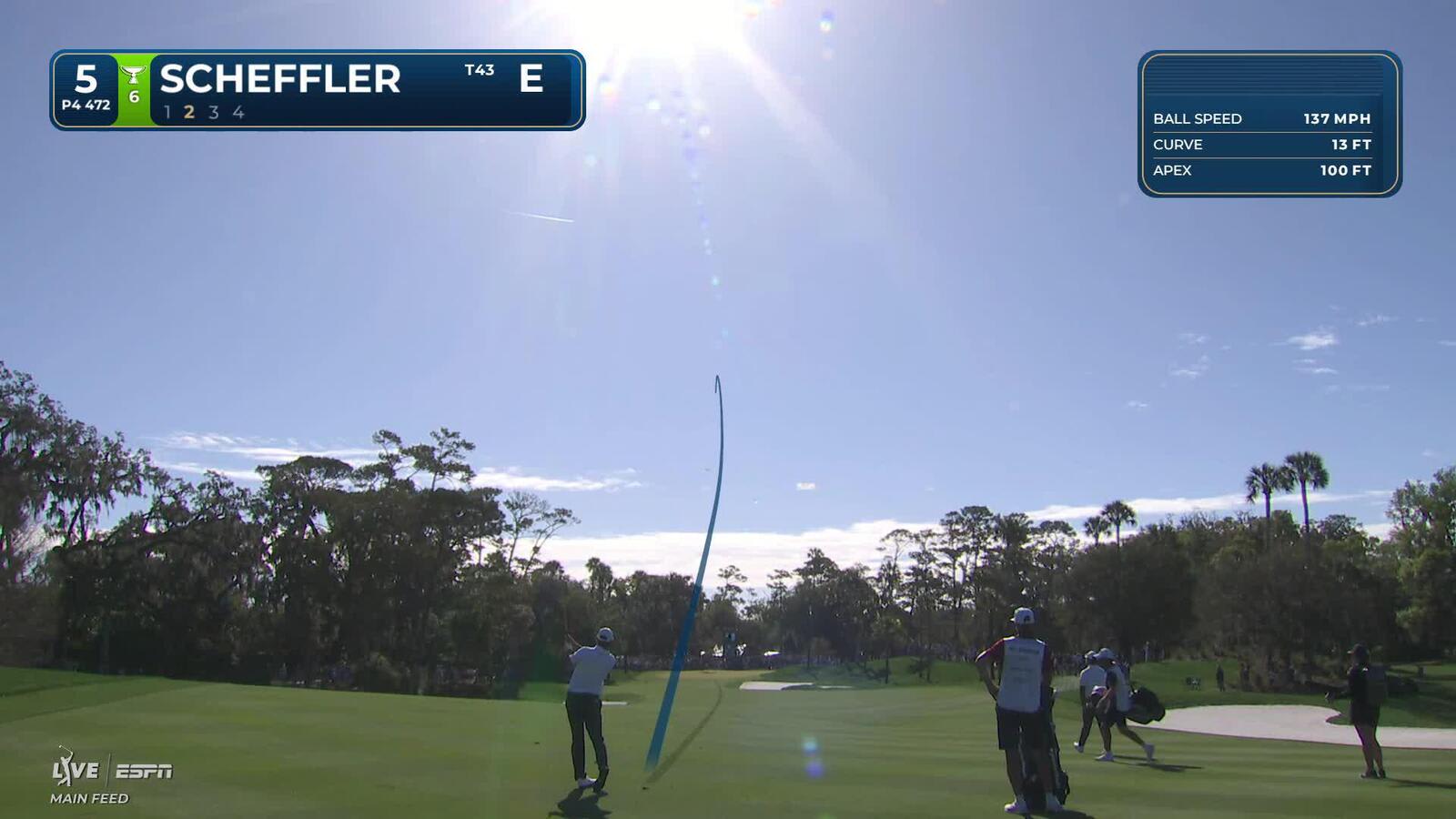
Scottie Scheffler hits 197-yard approach to 9 feet, sets up birdie on No. 5 at THE PLAYERS
Scheffler’s entire game is predicated on the basics. Every range session begins with a thorough check of his grip and stance. The idea is that no solution will be too far afield if it all stems from the rudimentary parts of his game. He’s had mediocre approach play weeks before, but the week-over-week malaise is new.
That’s why Scheffler planned to play the Texas Children’s Houston Open to continue working out the kinks and round into form for Augusta National, but he withdrew before the tournament began citing family reasons. The Schefflers welcomed the birth of their second child, Remy, last week.
That leaves the world and Scheffler in the dark about how his swing will hold up during competition. The next time he tests it will be under some of the highest pressure golfers face all year – a stern Augusta National test that prioritizes ball-striking above all else.
McIlroy’s struggles are harder to place. He was playing solid golf before the back flare-up at the Arnold Palmer Invitational presented by Mastercard. When he withdrew on Saturday morning of the tournament, he was in contention to win at Bay Hill, and given the incremental progress over the first few weeks of the season, he was expected to contend at TPC Sawgrass the following week. Instead, THE PLAYERS was a lost week. He was understandably rusty, making it hard to gather any sweeping takeaways. While McIlroy clearly arrived at Augusta National last year in the best form of his career, there’s little way to tell which version of McIlroy is driving down Magnolia Lane to defend his title. McIlroy even briefly considered adding an event before the Masters, but held off in favor of rest.

Rory McIlroy’s interview after Round 4 of THE PLAYERS
If we’re looking for further areas of concern beyond the injury, McIlroy’s record while in contention has been spotty since the Masters. He was outdueled in the final pairing by Chris Gotterup at the Genesis Scottish Open last July. He won the Amgen Irish Open in early September, a heartfelt victory in his home Open. But presented with another opportunity to win The Genesis Invitational in February, McIlroy was stuck in neutral, unable to capitalize as Jacob Bridgeman attempted to give it away on the final holes.
Then there’s the rest of the Masters field, which is chock-full of notable names rounding into form. Bryson DeChambeau and Jon Rahm figure to be major threats, both in form and in their past success at Augusta National. Gotterup and Bridgeman continue to impress. Cameron Young is playing as well as at any point in his career, now brimming with confidence after his breakout victory at THE PLAYERS. Ludvig Åberg is a perfect fit at Augusta National and has found form after a rough patch to begin the year. Tommy Fleetwood, Matt Fitzpatrick, Justin Rose and Robert MacIntyre have all flashed form. It’s hard to find a player inside the world’s top 15 that isn’t trending upward … except for the two at the very top: Scheffler and McIlroy.
Scheffler and McIlroy have dominated the sport in recent years in no small part because of their Masters performances. In an era without numerous Masters specialists at the peak of their powers, Scheffler and McIlroy are as close as we have to dominant course horses.
Is this the year that a third golfer enters their orbit?


