Nine things to know: Royal Birkdale, site of 2026 British Open Championship
11 Min Read

Scottie Scheffler closes out win at The Open
Players in Article
Players in This Article
The 154th Open Championship returns to England's northwest coast this week, where Royal Birkdale Golf Club in Southport will host golf's oldest championship for the 11th time, all since 1954.
1. Glorious coast
The 20-mile stretch of Merseyside coastline along the Irish Sea is among the richest and most concentrated collections of world-class golf anywhere. It's comparable to California's Monterey Peninsula, Long Island's East End or suburban London.
Royal Birkdale sits alongside Hillside Golf Club, which in turn borders Southport and Ainsdale Golf Club, host of the Ryder Cup in 1933 and 1937. Just down the coast lie Formby Golf Club, West Lancashire Golf Club, Wallasey Golf Club and Royal Liverpool Golf Club ("Hoylake"). All have served as championship venues for leading amateur and professional competitions.
If American golfers were to make just one golf pilgrimage across the Atlantic, a trip to this stretch of coastline would more than satisfy a lifetime ambition.
2. Incredible winners
Birkdale has seen some stunning championship winners – and challengers. Australian legend Peter Thomson won the first of his three consecutive Open Championship titles here in 1954 – as well as the last of his five career titles in the event in 1965. Arnold Palmer electrified a newfound throng of fans and single-handedly helped revive a struggling event when he won at Birkdale in 1961, the first of his two consecutive titles. Lee Trevino capped off a month-long binge, winning national titles in the United States, Canada and Great Britain when he beat the popular (and diminutive) Taiwanese golfer Lu Liang-Huan ("Mr. Lu") by a single stroke in 1971. In 1976, Johnny Miller's six-stroke victory was nearly upstaged by the breakthrough performance of a 19-year-old Spaniard, Seve Ballesteros, whose miracle chip on the 72nd hole threaded between two greenside bunkers for par, enabling him to tie Jack Nicklaus for second place.
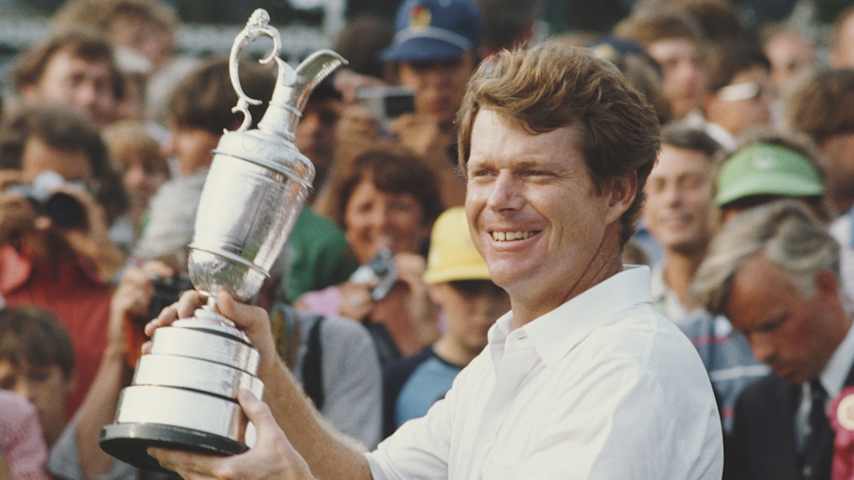
Tom Watson holds the slightly damaged claret jug at Royal Birkdale Golf Club after winning his second straight Open Championship in 1983. (David Cannon/Allsport/Getty Images)
Tom Watson won his fifth (and final) Open Championship in 1983 at Birkdale, with the help of what he called "the best 2-iron of my life" on the last hole to defeat Hale Irwin and Andy Bean by a shot. In 1991, Ian Baker-Finch shot 64-66 on the weekend, highlighted by a 29 on the front nine Sunday that saw him birdie holes 2-3-4-6-7 with approach shots that left him putts of only 6 to 12 feet. When Mark O'Meara won The Open at Birkdale in 1998, he needed a four-hole playoff over Brian Watts, though perhaps the most memorable play came from a 17-year-old amateur named Justin Rose, who stunned the crowd with a holed-out wedge for birdie on the 72nd hole that landed him in a tie for fourth.
In 2008, third-round leader Greg Norman, then 53 years old, nearly mounted a late-career triumph before faltering and giving way to eventual winner Padraig Harrington, who claimed his second consecutive Open Championship after winning the year before at Carnoustie. And in one of the event's greatest bounce-backs, Jordan Spieth, in 2017, made a miraculous bogey at the 13th hole, then played the next four holes in 5-under par to bypass his playing partner Matt Kuchar, who played those same holes in 2-under par yet still lost by three shots to the new leader.
3. Design history
The present golf course dates to an initial routing in 1897 by George Lowe (1856-1934). A native of Carnoustie, Scotland, he apprenticed in greenkeeping and clubmaking under Old Tom Morris. Lowe went on to become a prominent clubmaker and course designer, with much of his work in northwest England, including Lytham, Hesketh, and Southport and Ainsdale.
The course was subsequently redesigned in 1932 by five-time Open champion John Henry "J.H." Taylor (1871-1963), in tandem with his design partner, Frederick George Hawtree (1883-1955), into more or less its present form. The mandate for that complete rerouting was to create a championship-level course, making Royal Birkdale one of the first such purpose-built links in the country. With its towering dunes that accommodate thousands of spectators, easy road access for regional traffic, and spaciousness for event infrastructure, the course has proven ideal for such large events. Small wonder its championship history includes 11 Open Championships (including 2026), two Ryder Cups, six AIG Women's Opens, five Amateur Championships, a Senior Open, a Walker Cup and a Curtis Cup.
For much of the 20th century, the three generations of the Hawtree family that formed Britain's leading dynasty of golf architects included work at Royal Birkdale in their portfolio. In the post-World War II era, they variously oversaw routing changes involving the par-3 12th and the later holes of the back nine, in the process undoing an unusual finishing par run of 5-3-5-4-5-5, which is how the course played during The Open Championships of 1965, 1971 and 1976.
4. Recent changes
Given Birkdale’s significance as a championship venue, neither the club nor The R&A has been reluctant to improve the facility, which is why in 2021, Royal Birkdale turned to the internationally renowned firm of Tom Mackenzie and Martin Ebert for guidance. The design firm has a worldwide reputation for new and classic restoration projects, including Hirono Golf Club in Japan, Royal County Down in Northern Ireland and numerous Open Championship venues.
The results of their work at Royal Birkdale, led on site by Mackenzie, are considerable. They include a complete redesign of the short par-4 fifth hole, shortening and rebuilding the par-3 seventh, elimination of the old par-5 14th hole, a new par-5 14th hole largely in the place of the previous par-5 15th, and a completely new par-3 15th hole that, in length, character and direction, varies markedly from the previous par 3s. The elimination of the old 14th hole also created open space to move the practice green nearly 200 yards east, closer to the clubhouse. It also created room for a short-game practice area.

An aerial view of the 553-yard, par-5 14th hole (right); the new 202-yard, par-3 15th hole (center); and the 355-yard, par-4 16th hole (left) at Royal Birkdale Golf Club. (David Cannon/Getty Images)
Along the way, Mackenzie and Ebert eliminated 14 bunkers, tying the remaining rebuilt bunkers more dramatically into the framing dunes while replacing those previously hazarded areas with short-cut ground. The result is a more nuanced approach to strategy, penalty and recovery.
According to Ebert and Mackenzie, the work was undertaken in accordance with the following mandate from the club: “To improve and develop the golf course with the modern game in mind for its members, visitors and championships for the future. While history is important and to be considered as part of the research, we are not looking for a restoration project. All changes must be relevant to the current aesthetics, topography and sympathetic to the [ecological designation as a] Site of Special Scientific Interest.”
5. That iconic clubhouse

A view of the 18th hole (par 4 during The Open Championship) with the clubhouse behind at Royal Birkdale. (David Cannon/Getty Images)
For all its classic sensibility as a golf course, Royal Birkdale has one fascinating anomaly that generates steady conversation, if occasional criticism: Its heavily stylized Art Deco clubhouse in the Streamline Moderne style looks like someone parked the upper deck of a steamship on the grounds. It was designed by local architect George E. Tonge in 1935, who won a competition with his submission. His other local claim to architectural fame is the old Garrick Theatre in downtown Southport, which was converted into a bingo hall and is now an abandoned shell of its former grandeur. The Birkdale clubhouse is not entirely unique; similarly stylized versions of Art Deco clubhouses can be found at Cabot Highlands in Inverness, Scotland, and at Hayling Golf Club on England’s southern coast.
6. Playing character
With low-lying fairways wending through towering dunes, many of them 20 to 40 feet high, Royal Birkdale provides a naturalistic version of stadium golf in a links setting. In fact, the relatively modest fairway contours have had to be supplemented with drainage to keep low areas from playing perennially wet. The upgrades to the course include partial lifting of greens into raised platforms, as well as raising some bunkers above the water table to ensure they drain and play firm. The result is a set of bunkers that are, in essence, revetted pits, very punitive along the fairways in that they limit the possibility of playing all the way to the green. In other words, they are to be avoided at all costs.
The play here is decidedly along established shortcut fescue corridors. The fairway width provides a smaller central playing surface than at several modern major venues, including Aronimink Golf Club for the PGA Championship and Shinnecock Hills Golf Club for the U.S. Open. Royal Birkdale is not “bomb-and-gouge” golf, nor is it a matter of taking shortcuts.

The claret jug sits on display near the 18th green at Royal Birkdale Golf Club ahead of The Open Championship. (David Cannon/Getty Images)
The greens are modest in average size and tamer compared to those at recent major championships, mainly to accommodate prevailing winds, which often blow 10 to 20 mph. Most greens are bunkered at four o’clock and eight o’clock, not across the front at six o’clock. They allow for a measure of ground-game access if the approach contours are properly read. Moreover, they are not heavily bunkered deep into the putting surfaces, which encourages bold aerial play to the back half of greens for those who can control approaches in the wind.
The result is a course that encourages controlled play, often with a fairway metal or long iron off the tee, given the imperative of playing approach shots from fairways rather than from dense native rough or dune formations along the side. It is a course that rewards cautious play – thus winners like Thomson, Baker-Finch and O’Meara – as much as bolder players like Palmer and Watson. Or ideally, those who embody both styles, like Miller in his heyday or Harrington and Spieth in theirs.
7. Fifth hole, par 4, 321 yards
This hole, originally the first until the clubhouse was moved in 1935, had perennially been Birkdale’s red-headed stepchild. It was short, awkward in appearance due to a pond that was out of place and character, lacked meaningful options off the tee, and was in perpetual poor condition due to standing water and moisture buildup.
No more. Mackenzie and Ebert have thoroughly reimagined this hole while keeping it in place. Shortening it by 25 yards has brought it into a more accessible range of drivable for more players, though it does tend to play into a prevailing breeze from the southwest. Extensive fairway bunkering now affects players whether laying up or going for the green, whereas before the safe line of play was without thought or risky consequence. Moving the green up and slightly to the left has made it visible off the tee and created the chance to drain it properly rather than having it sit in wet mire. The move also created space behind for lengthening the long par-4 sixth hole. The par-4 fifth hole has finally become interesting and attention-getting rather than simply bridging the space between the fourth and sixth holes.
8. 15th hole, par 3, 241 yards
Among Birkdale’s longstanding quirks was a lack of diversity in par 3s. Three of the par 3s ran south/southeast, measuring 178, 184 and 201 yards, and the other ran in the exact opposite direction (north/northwest) at 201 yards, leading to a lack of significant difference in shot, club and challenge. That has now been addressed with abandonment of the last par 3 and its replacement with a new hole, the 15th, running 241 yards in a northeasterly direction toward the clubhouse. The club was fortunate to have the ground, though to maximize playing width, the preceding hole (the new par-5 14th) had to be shifted slightly right, and the following hole, the old par-4 16th, saw its teeing ground moved slightly left.
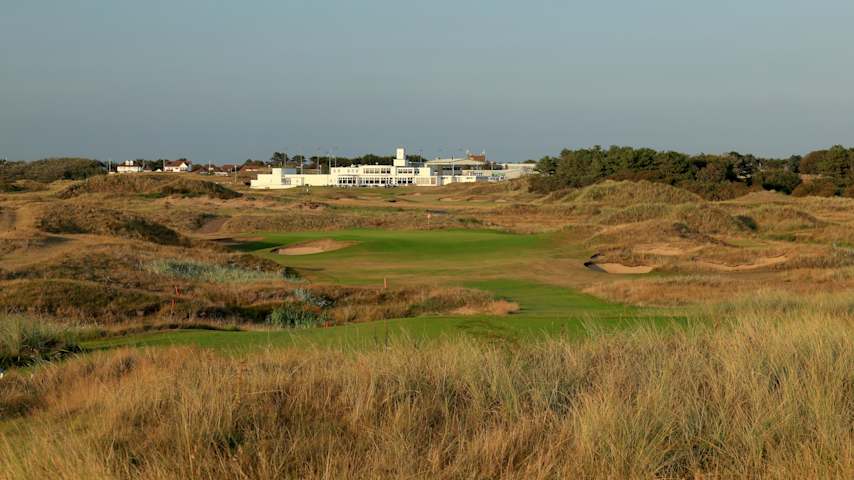
A view of the new 202-yard, par-3 15th hole at Royal Birkdale Golf Club. (David Cannon/Getty Images)
The result is a dramatic, slightly downhill hole to a platform green with bold bunkering along its left side and a steep fall-off to the right and behind. Frontal bunkering has been pulled well forward, creating ground at the entrance for a well-placed run-up to land and bound on. An alternative shorter tee will also be available when the hole is cut in a more demanding back-left corner or when wind conditions shift dramatically.
9. 18th hole, par 4, 508 yards
A par 5 for members and guests but a stout par 4 for the world’s finest golfers, the 18th has been tightened in the landing area and made more demanding the entire way. The hole tends to play downwind, with a quartering breeze over the golfer’s right shoulder so that the distance is foreshortened under actual playing conditions. What used to be a right-side teeing ground that forced players to shape their drive left to right has been abandoned for a more natural starting point that leads to a straighter hole lined up with the club’s stylish clubhouse. For everyday golf, the landing zone has been widened, but the drive zone is narrowed and heavily bunkered some 250 to 340 yards out for The Open Championship play.

An aerial view of the 501-yard par 5, 18th hole (plays as a par 4 in The Open Championship) at Royal Birkdale. (Photo by David Cannon/Getty Images)
The approach has also been tightened, with the two left-side bunkers made famous in 1976 by Ballesteros’ chip shot moved marginally closer to the green. An offsetting bunker on the other side has been shifted deeper into the right flank, creating more ground-game access on that side and a much enlarged short-game recovery area for approach shots or bailouts that drift off line. The result is a harder finishing hole and, it is hoped, more drama for spectators amassed around the green to observe the pressure of finishing play.
Royal Birkdale Golf Club scorecard
| Hole | Par | Yardage |
| 1 | 4 | 447 |
| 2 | 4 | 419 |
| 3 | 4 | 450 |
| 4 | 3 | 219 |
| 5 | 4 | 321 |
| 6 | 4 | 514 |
| 7 | 3 | 151 |
| 8 | 4 | 459 |
| 9 | 4 | 414 |
| 34 | 3,394 | |
| 10 | 4 | 397 |
| 11 | 4 | 434 |
| 12 | 3 | 186 |
| 13 | 4 | 502 |
| 14 | 5 | 692 |
| 15 | 3 | 241 |
| 16 | 4 | 393 |
| 17 | 5 | 566 |
| 18 | 4 | 508 |
| 36 | 3,829 | |
| 70 | 7,223 |