
Scottie Scheffler calls PGA Championship pin locations 'hardest' he’s faced
3 Min Read
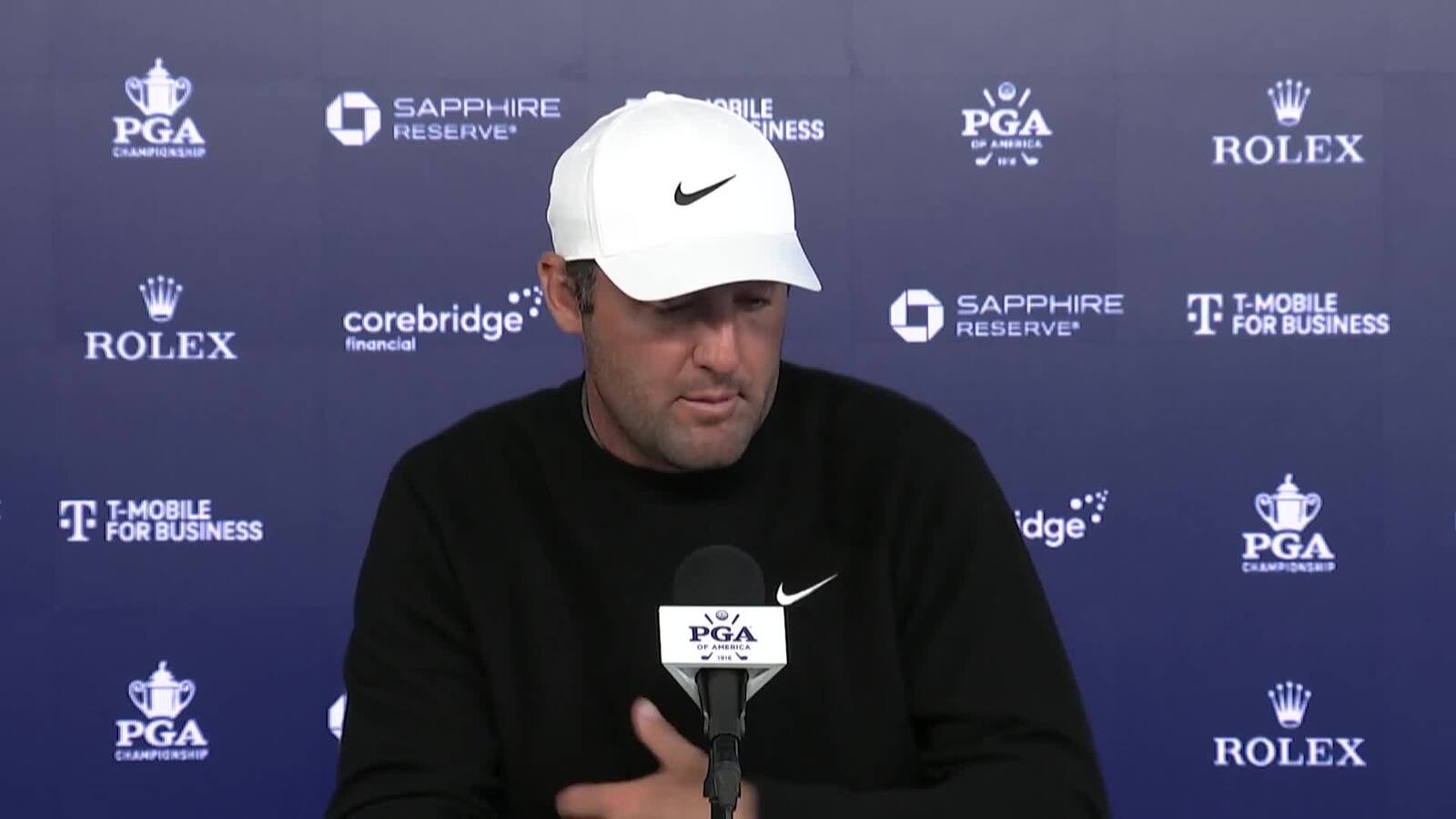
Scottie Scheffler on extremely difficult pin locations at PGA Championship
Players in Article
Players in This Article
NEWTOWN SQUARE, Pa. – As practice rounds commenced and the golfers familiarized themselves with Aronimink Golf Club, a loud, firm consensus began to take shape: This PGA Championship was going to be easy.
The course isn’t overly long, nor is the fairway rough prohibitively lengthy. The greens are severely sloped, but in practice rounds, the pins are placed at the center of the greens, and from there, the test seemed simple. That led some to wonder how long this championship might go.
Could someone hit 20 under? Is this course built for the modern men’s professional championship?
Scottie Scheffler realized it would be tough on Wednesday evening when the PGA of America released the pin locations for the next day.
“You see it, you're like, oh, wow, they're pushing these things as far as they can,” Scheffler said.
Scottie Scheffler on extremely difficult pin locations at PGA Championship
From there, the edict was clear. This tournament wouldn’t be what many expected. In fact, the opposite was true, and Friday was its opus. As winds swirled and temperatures cooled, the morning half of the field experienced a stiff test. Aronimink provided the canvas to take advantage of those advantageous conditions, and the PGA of America setup team was ready to oblige in how they set up the course. Nearly every pin was tucked in a far corner of the green, or just on the other side of a severe slope.
“Most of the pins today were, I mean, kind of absurd,” Scheffler said. “They were just so far into the areas where we thought the pins were going to be.”
Scheffler’s score was fitting for that challenge, a 1-over 71 that moved from overnight co-leader to chaser. He sits 2-under overall, three strokes back of the lead. Scheffler’s over-par round is his first in this championship since the third round in 2024.
“This is the hardest set of pin locations that I've seen since I've been on TOUR,” he said, “and that includes U.S. Opens, that includes Oakmont.”
Need specific examples? Scheffler provided plenty. Let’s start with the par-4 10th, where Scheffler began his second round. Tucked in the back left portion of the green, there was no margin for error if Scheffler missed long. Anything more than a pace behind the pin would jettison off the back and create a near impossible up-and-down.
“I'm sitting there, the wind's blowing 20, 25 miles an hour right-to-left, and I got a green that goes like down right-to-left into a valley, up left-to-right, back right-to-left,” Scheffler said.
You’re forgiven if you can’t quite visualize all of that. That was Scheffler’s point. The greens scramble your mind. He missed right with his approach shot and attempted to get it on the back left shelf, but didn’t hit it hard enough, leading to a two-putt bogey.
Need another? How about the par-3 14th? Scheffler called that pin location one of the “craziest" he’s ever seen, sitting on a spine that cambered away in every direction.
“That was like they put the pin on like this microphone, like it was just like a high point,” he said. “I hadn't seen anything like it. You saw, I made a really good 3 1/2-footer there, and if you don't start that perfectly online, it's probably not touching the hole.”
Or what about the par-4 second hole? That pin was pushed all the way to the back edge of the green. And like the 10th, it was especially penal for any miss that rolled more than a few paces past.
“With how much the wind is blowing and where the pin is located, this isn't really the time for me to try to shove one back in there,” Scheffler said. “Just get in there about 30 feet and 2-putt and get out of there.”
Scheffler was clear to distinguish hard from fair. He didn’t believe anything about the setup was unfair; it was just extremely difficult.
That’s the challenge Aronimink provides. The greens are its defense, and through two rounds, they have suppressed scores further than anyone expected.