Horses for Courses: Only strongest players can handle demands of Augusta National
8 Min Read

Golfbet Roundtable: Key trends for making picks at the Masters
Players in Article
Players in This Article
Just like that, major season has finally arrived. It’s the week of the Masters. This week, the golf world’s full attention turns to Augusta National Golf Club, the only major championship played on the same course year after year. It’s a place rooted in history and tradition, and it asks a different kind of question than any other course on the schedule.
It’s more than slipping on the green jacket come Sunday. It’s about legacy. For many in this field, it’s the pursuit of a first major title, and there’s no better place to do it than Augusta.
Look at the list of past champions, and it tells you everything. Multiple major winners, former world number ones, and a long list of Hall of Famers. Winning the Masters doesn’t just happen. It almost always finds the elite. That’s what makes this week so special. There’s an understanding that not everyone in the field truly has a chance. Only those strong enough mentally and physically can handle what Augusta demands.
With the Masters being the only major played at the same course every year, the amount of data we can use is as strong as anywhere. Augusta National is one of the most predictive courses the pros play at, which gives us a real opportunity to narrow down who fits.
Augusta National is a 7,565-yard, par-72 course with four par 3s, 10 par 4s and four par 5s. The greens are average in size at around 6,486 square feet, but what makes this course challenging is the undulation. It’s not just drastic undulation on the putting surface; it’s everywhere.
At Augusta, it’s more than just going out and playing good golf. It’s understanding the golf course. That’s why Fuzzy Zoeller in 1979 remains the last player to win here in their first appearance. You have to learn where to miss, how to use the slopes, and how to be creative on and around the greens.
On paper, it can look fairly straightforward. The rough is short at about 1.4 inches. Fairways are relatively easy to hit. There aren’t many bunkers or water hazards in play. But it’s extremely difficult to hit these greens in regulation, and even harder to avoid three-putts once you’re on them.
With limited rain in the Augusta area and some wind leading into the week, there’s a real expectation that this course plays fast and firm. That adds to the already difficult course.
That’s where the data comes in. Augusta gives us a large sample size to work with, and one of the first things I like to look at is course history from a strokes-gained perspective.
Here are the golfers who’ve gained the most strokes at Augusta National over their last 36 rounds. Not everyone has a full 36-round sample, but most are close enough to use as a reliable data set (data via Betspertsgolf.com):
In 2024, there was a real belief that Ludvig Åberg could buck the trend of first-timers not winning here. He finished solo second in his debut and followed that up with a solo seventh in 2025. What really stands out is that he’s gained a combined 11.7 strokes putting in just two appearances, which is almost unheard of at Augusta, given how difficult these greens are to learn.

Ludvig Åberg makes birdie on No. 18 at Valero
I’m not sure I’m ready to go all the way in on Åberg outright, but if you did, I wouldn’t blame you. Over his last three starts, he’s done nothing but contend. Third at the Arnold Palmer Invitational presented by Mastercard, then back-to-back top fives at THE PLAYERS Championship and the Valero Texas Open. It’s hard not to see him having another strong week here. You can find the top 20 around -125 or even the top five at plus money, and both feel like solid ways to play it without needing him to win.
Winning at Augusta still comes down to scoring in the right places. There are only four holes that play under par on average, and all of them are par 5s. That means you have to take advantage of those opportunities when they arise while limiting mistakes elsewhere.
Strokes Gained: Par 5s last 12 months
- 1. Jake Knapp
- 2. Tyrrell Hatton
- 3. Bryson DeChambeau
- 4. Sergio Garcia
- 5. Rory McIlroy
- 6. Gary Woodland
- 7. Scottie Scheffler
- 8. Min Woo Lee
- 9. Bubba Watson
- 10. Ludvig Åberg
On top of that, approach play is everything here. Augusta is one of the toughest courses on TOUR to gain strokes on approach, and the winners reflect that. Since 2019, every winner except Scottie Scheffler in 2024 ranked inside the top seven in strokes gained approach for the week.
Putting on the other hand is not overly important. Or at least the best putters aren’t always the best option here.
In fact, only one winner finished inside the top 10 in Strokes Gained: Putting during their victory. Rory McIlroy (+1300) won last season while ranking 59th in putting, which tells you everything you need to know about this place. Approach play is what separates contenders here. You can get away with being an average putter, but you can’t survive without elite iron play. There’s no hiding at Augusta, especially from the middle of the fairway.
Strokes Gained: Approach last 36 months
- 1. Collin Morikawa
- 2. Si Woo Kim
- 3. Adam Scott
- 4. Nicolai Højgaard
- 5. Ryan Gerard
- 6. Kurt Kitayama
- 7. Akshay Bhatia
- 8. Viktor Hovland
- 9. Daniel Berger
- 10. Tyrell Hatton
Even with all the data, there are still trends that show up year after year. And everyone loves Masters trends:
- Fifteen of the last 17 winners had at least four previous career wins.
- Fourteen of the last 20 winners had gained at least 18 strokes tied to green in the last four events before the Masters win.
- Fourteen of the last 16 winners ranked inside the Top 40 in par 4 scoring in the year leading up to their Masters wins.
- Twenty-six of the last 28 winners had finished 30th or better in a previous Masters.
There’s still a lot of golf to be played, and there are question marks around some of the top players, which could open the door. But more often than not, this is a tournament where the best players rise to the top. The edge comes from backing golfers who are playing elite golf right now and fit what this course demands.
Best Value on the Board
Matt Fitzpatrick Top English +250 | Top 10 +215
The line movement on Matt Fitzpatrick (+2300) to win the Masters has been very interesting, to say the least. Just a few months ago, he was sitting at +12500. Now, he is as low as +1800 at some shops. While that kind of movement is eye-opening and often scary, it makes a ton of sense. Fitzpatrick has a real chance to win the Masters.
Since the Omega European Masters back in August, Fitzpatrick has been playing some really good golf. Still, the stretches of elite approach play really started to show in November when he won the DP World Tour Championship. In that event, he gained 4.5 strokes on approach. He took a slight step back at The American Express, which was his first American start of the season, but he still gained on approach. He followed that with a solo ninth at the WM Phoenix Open, where he gained 4.3 strokes on approach and an absurd 11.2 strokes tee-to-green.
The great iron play did not stop there. He was a massive gainer at the AT&T Pebble Beach Pro Am and again at the Genesis Invitational. Then once he got to Florida, things really took off. He had the lead late on Sunday at THE PLAYERS Championship before Young put together an incredible two-hole stretch to steal the trophy. Even in defeat, Fitzpatrick was outstanding. He gained throughout the bag, was excellent off the tee, sharp with his irons, strong around the greens, and even rolled the rock well.
Then what did he do the following week? He won the Valspar Championship, and he did it by gaining another 4.6 strokes on approach.
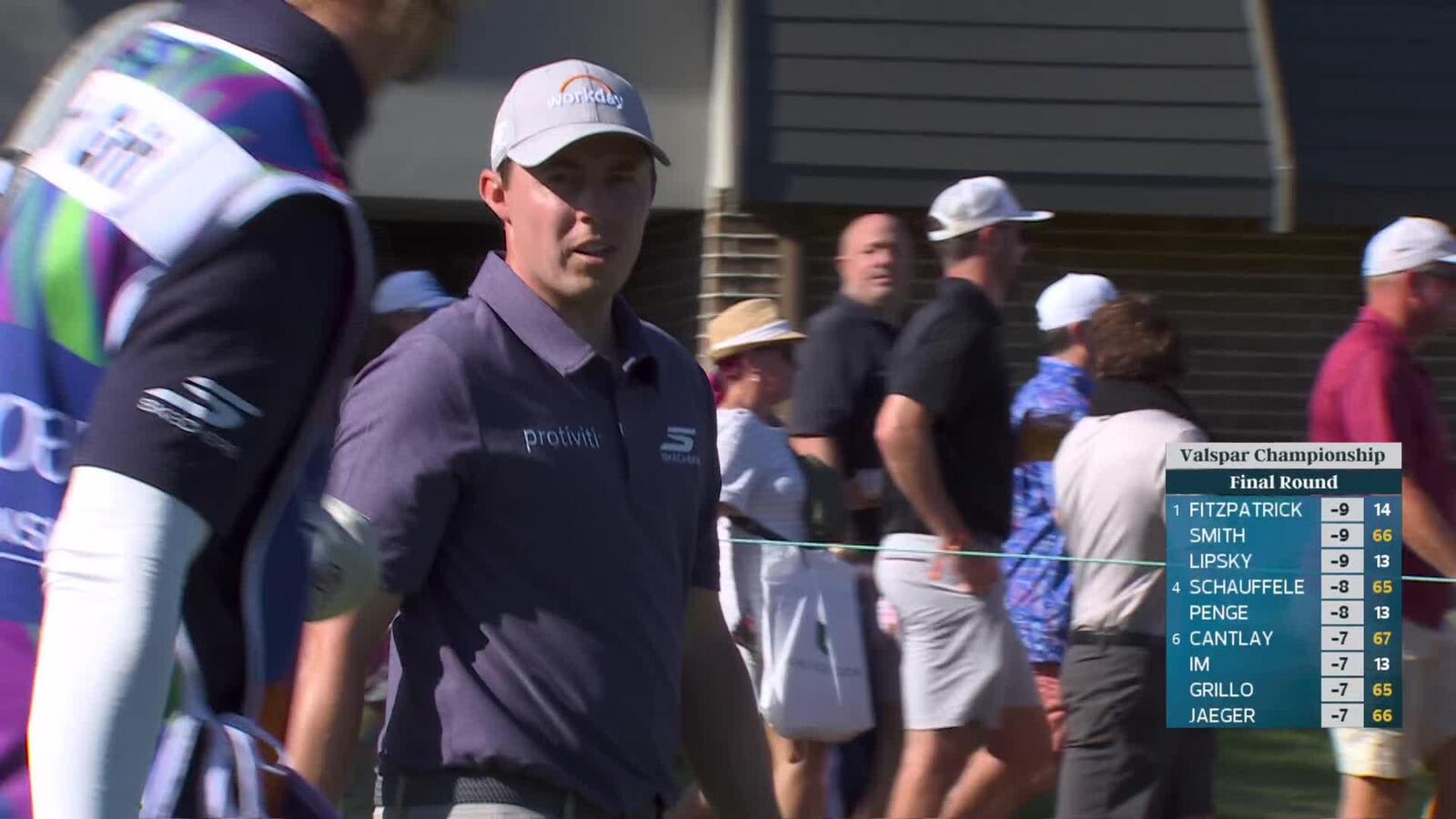
Matt Fitzpatrick sinks clutch 30-foot birdie putt on No. 15 at Valspar
We keep talking about how important approach play is at Augusta National, and Fitzpatrick checks that box in a big way. Over the last 36 rounds, he ranks sixth in this field in Strokes Gained: Approach. It’s not just the Florida Swing that bolsters those numbers. Stretch that sample size to 50 rounds, and he jumps all the way to second. That shows that it’s not just some random spike. It’s consistent and worth noting.
I like him to win. Do I know if +2300 is still a palatable outright price? I am not totally sure. I bet him early in February after he gained a blistering 8.1 strokes ball-striking at the WM Phoenix Open, and that number was +8000. That price didn’t stand a chance.
At this stage, I think Fitzpatrick finishing as the top English golfer gives you a little more protection against some of the other names near the top of the board.
If you want to take it a step further, I do not mind looking at Fitzpatrick's top 10 or top 5 either. And if your book offers it, the each-way market with five places makes a lot of sense too.
This feels like a week that is set up for Fitzpatrick to add another major championship to his resume.
Bryson DeChambeau First Round Leader +2000 | First Round Top 20 -125
DeChambeau’s first trip to Augusta in 2016 resulted in a T21, which was solid. But from 2021 to 2023, when he was going through major swing and body changes, the results weren’t there. Missed cuts in 2022 and 2023, and a T46 in 2021. During that stretch, he was losing strokes in just about every category, which is a recipe for disaster at Augusta.
Things started to turn in 2024. He began gaining strokes off the tee, improved on approach, and the putting followed. In 2025, it was more of the same. Even while losing 4.2 strokes on approach, he still finished inside the top five.
I like DeChambeau to win this tournament, but the first-round leader market is where the value really is. He’s one of the best first-round golfers in Masters history, and he has the spike rounds to back it up. He’s been a first-round leader here multiple times and has shown he can fire mid-60s rounds at Augusta.
The price is nearly double his outright, which feels off. You’re getting a much better number without needing four perfect rounds. Add in a 10:07 a.m. starting time where conditions should be softer and winds lighter, and it sets up well.
If he spikes early, you’re live for the lead. And even if he doesn’t, his floor still gives you a strong chance to cash that first-round top 20.
For resources related to problem gambling, call or text 1-800-MY-RESET.