Aaron Rai emerges as unexpected PGA Championship winner from unexpected background
8 Min Read
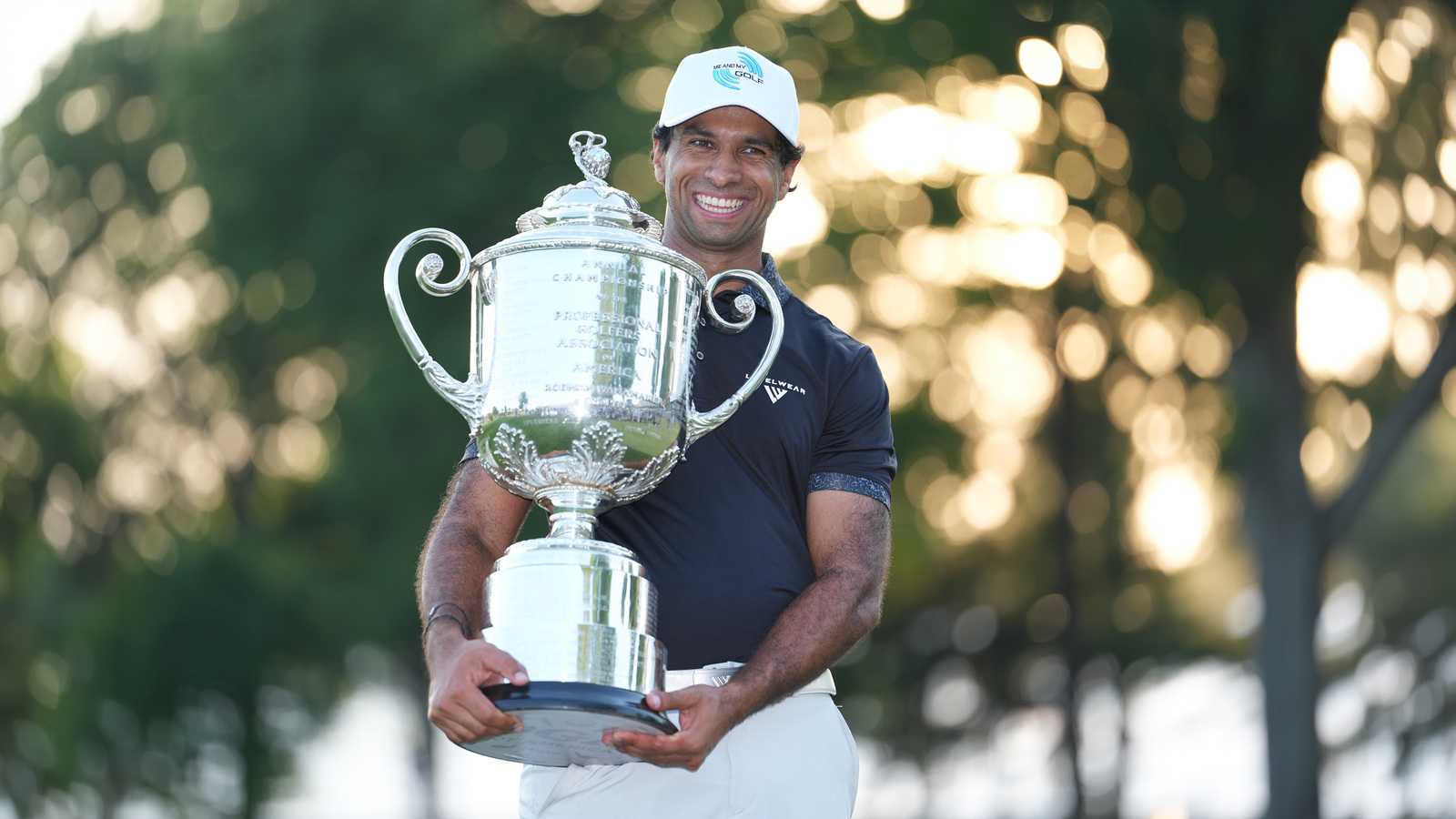
Englishman Aaron Rai wins 108th PGA Championship
Players in Article
Players in This Article
NEWTOWN SQUARE, Pa. – This was the PGA Championship that shocked us all.
It was supposed to be the week that pro golf brought Aronimink Golf Club to its knees with long drives and low scores. That was wrong.
Players expected difficult pin locations. They were wrong. Instead, they got some of the hardest pins we’ve seen in a modern major championship.
The leaderboard was historically bunched on Sunday, with multi-time major winners dotted across the top of it. The expectation was that it would remain tight until the very end. That was wrong, too.
The biggest, most memorable surprise of them all, the only one we will remember in 10 years, is that amidst a pack of chasers that included Rory McIlroy, Jon Rahm, Scottie Scheffler, Justin Thomas and Xander Schauffele, the unheralded and unphased Aaron Rai emerged as one of the most unexpected winners in recent major championship memory, setting history along the way.
In its 108th playing, Rai is the first Englishman to win the PGA Championship since Jim Barnes won the first two. He’s also the first player of Indian descent to win a men’s major championship. He broke through both barriers emphatically, playing the last 10 holes in 6 under to separate from a tournament that was previously inseparable, beating Rahm and Alex Smalley by three strokes.
The shots Rai executed on Sunday afternoon are worthy of discussion. The bunker shot at the 13th that set up a birdie and a two-shot lead was exquisite. Rai’s majestic second shot on the par-5 16th assured another birdie and more breathing room. The winding, 68-foot birdie that dropped on the 17th will come to define this victory in perpetuity.
But the path that led Rai to this moment is worth lingering on.
“Everyone playing in the field this week has a great journey to be able to share,” Rai said, “and I'm no exception to that.”
Rai was born in Wolverhampton, England, the son of two immigrants. His mother, Dalvir, immigrated from Kenya as a teenager and his father, Amrik immigrated from India. Dalvir worked multiple jobs and Amrik was a community worker. They wed and had Aaron, their first.
Golf was never the plan. Rai’s introduction to golf was an accident. He hurt himself while playing with a hockey stick as a toddler, and, in an effort to make things safer, Dalvir went to buy plastic sticks. She returned with plastic golf clubs instead.
Amrik was an avid tennis player. He didn’t play golf. Nobody in Rai’s family did. But while taking his son out to practice tennis, he noticed Rai’s form was far more like a golf swing than a tennis motion. He was destined to be a golfer.
As the story goes, Rai won his first tournament at age 4, a 12-and-under event. Quickly, Rai became obsessed. He and Amrik watched old VHS tapes of Tiger Woods on repeat, averaging three or four viewings per week. He was Rai’s sporting idol.
Amrik, in hopes of helping his child progress, sought out every bit of info on the golf swing that he could. He helped Aaron along as best he could in the early years, before seeking out two locals, Andrew Proudman and Piers Ward, who would later form the teaching company Me and My Golf – the sponsor that Rai now dons on his chest and hat. Together, that support system willed him forward using a unique method.
While Rai played the occasional junior golf tournament, he was largely isolated from golfers his age. Until age 12, almost all of the golf Rai played was off a customized course length. Meaning he would start from the fairway and play the holes to fit his length, with the idea that he would become great at the fundamentals of the game while incrementally adding distance and working his way up to a full course.

Aaron Rai on playing custom course lengths growing up
It was through this process that Rai’s work ethic fully formed. There were no shortcuts nor trophies to chase, only internal improvement.
Around the age of 8, as Rai continued to get better, Amrik reached out local papers to raise awareness and perhaps some funding for Rai’s pursuits. It’s how one of Rai’s defining quirks came to be. A glovemaker reached out and sent a pair of gloves to the family. Rai took to them right away. A few weeks later, Amrik forgot to put them in his golf bag, so Rai played with just one. He was terrible.
“I couldn't play, I couldn't feel the grip, so I've always stuck with the two gloves ever since,” Rai said.
It was also around this time that Rai’s other quirky habit materialized. When Rai was seven, Amrik bought him an expensive set of Titleist irons and instilled the need to respect and care for his possessions. After every use, they cleaned the clubs meticulously, wiped them down with baby oil to avoid any rust and put them in iron covers. The baby oil habit has fallen off, but the iron covers remain.
“There's little quirky things he does in the golf game, but I think that just keeps him grounded in a way,” his caddie Jason Timmis said.
Timmis grew up playing junior tournaments with Rai. He eventually realized Rai was “much better” than him and started caddying for him in 2019. These habits were fostered in that contained environment, which meant they stuck when he finally began playing with other juniors.
“I didn't really mix with a lot of other junior golfers, which didn't give me a perspective of what was normal,” Rai said. “So I think he kind of sheltered me to be able to develop in a way that made sense for me, in a way that I guess was a little bit unique with two gloves, with iron covers, et cetera. I think by the time he probably allowed me to play more kind of club golf, play professional golf, I felt like I was strong enough in why I did certain things to be able to continue to move that forward. I knew the reasons why I do them. I believe in the reasons why I do them. So I had no reason to really shift from that as I got older.”
As Rai assimilated into the junior golf scene, he quickly established himself. He became a bit of a teenage sensation in England as a 15-year-old when he beat the "Lee Westwood World Puttmaster Record" by holing 207 consecutive 10-foot putts. Then, two years later, he turned pro.
“I probably wasn’t ready,” he would later say.
His support system steadied him. After two years without a consistent tour to play on, Rai found a place on the now-defunct PGA EuroPro Tour (Tommy Fleetwood was also a member at one point). He won 886 pounds in his first year in 2014 – the same year McIlroy won two majors – and struggled to acclimate to the competition, most of which were hitting it further, putting better and outsmarting him. The carrot for Rai wasn’t money, but status on the HotelPlanner Tour (the DP World Tour’s version of the Korn Ferry Tour), given to the top finishers. That came in 2016 after he finished No. 5 on the Order of Merit. He won an event in his second season on the HotelPlanner Tour, which earned him DP World Tour status. He remained in Europe full time until 2020, when he moved to the U.S. and earned his TOUR card through the Korn Ferry Tour Finals.
The pattern of incremental growth continued stateside. He finished 93rd in the FedExCup in his rookie year, then qualified for the Playoffs and finished 68th in 2022-23, his second year. In his third season, he won, outdueling Max Greyserman in the dark at the Wyndham Championship.
Now he’s a major champion.
“It's a really long journey to even get to compete at major championships at events like the PGA (Championship),” Rai said. “Yeah, to be stood here, it still hasn't sunk in for sure.”
Any major champion has to endure a bit of strain on their path to victory. Rai came on the front nine on Sunday. He birdied the first hole and fourth holes, but dropped shots at the third, sixth and eighth holes, falling behind by three strokes.
Rai and Timmis had a talk as they walked to the ninth tee. Timmis told him he needed to be more precise and intentional about his shot flights and shot shapes. The same type of meticulous details that were drilled into Rai by his dad as a youngster. Two shots later, Rai found himself on the par-5 green with a 40-foot eagle putt. He drained it. It reinvigorated him. He picked up another birdie at the 11th, which officially gave him the lead. Then the heroics ensued down the stretch.
With each passing birdie, the unexpected began to actualize. McIlroy failed to take advantage of the gettable holes up ahead. Matti Schmid faded. Jon Rahm was stuck in neutral.
The one that emerged was Rai, the unknown quantity from an unconventional background winning an unusual tournament.
Fitting.
This PGA Championship was molded by those incredible shots down the stretch. The man who won it was molded long before.