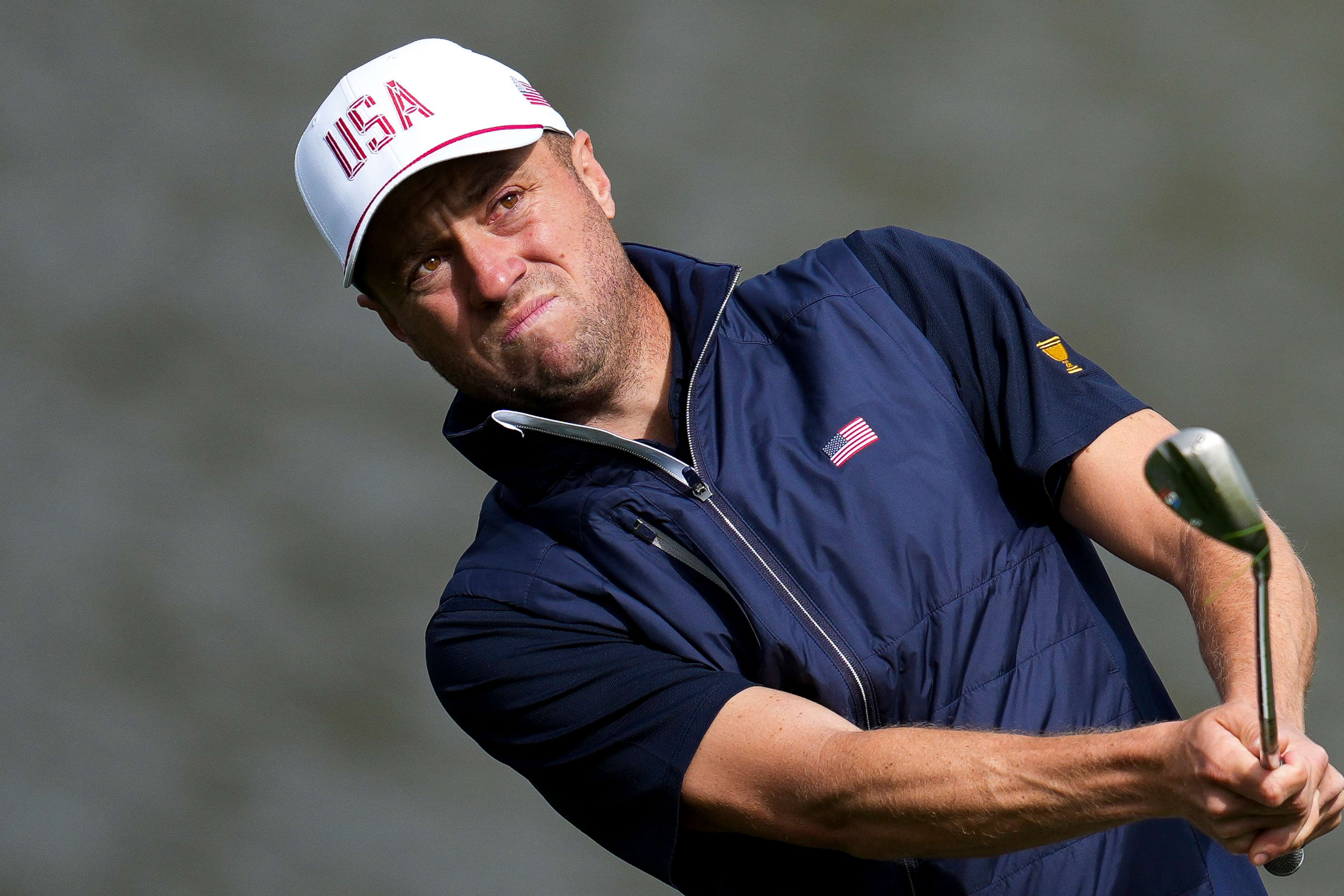
Nine things to know: All about Medinah Country Club, host of 2026 Presidents Cup
11 Min Read

Presidents Cup captains square off on Medinah Country Club’s short course, Camel Trail
Players in Article
Players in This Article
The teams for the 16th biennial Presidents Cup, played Thursday through Sunday, are all set. Both U.S. Team Captain Brandt Snedeker and International Team Captain Geoff Ogilvy know that the four-day match-play competition is more closely contested than the 13-1-1 record of American dominance indicates. The event includes four sessions of two-man alternate shot (Foursomes) and best ball (Four-ball), plus one-on-one singles matches on Sunday.
Storied Medinah
The venue, Medinah Country Club, is a classic American parkland layout, located 26 miles due west of the downtown Chicago Loop. The club dates to 1924 and occupies 640 acres (a full square mile) of lightly rolling former prairie land. There, 1,200 members enjoy access to three 18-hole golf courses and one of golf’s most magnificent clubhouses: a 120,000-square-foot palace combining Byzantine, Asian and Middle Eastern-inspired elements, replete with cupolas, hand-painted mosaics covering a domed interior, and a 60-foot-high rotunda.
The club’s showcase is Course No. 3, site of this year’s Presidents Cup, which has been home to the Western Open (1939, 1962, 1966), U.S. Open (1949, 1975, 1990), PGA Championship (1999, 2006), 1988 U.S. Senior Open and 2012 Ryder Cup. Also hosting the 2019 BMW Championship, Justin Thomas parlayed a course-record 61 into a winning total of 25-under par 263. Since then, the course has undergone a major transformation.
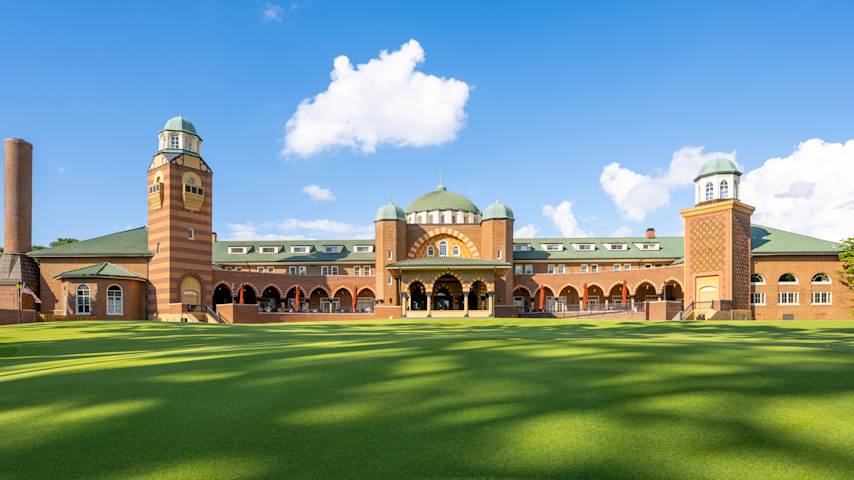
A look at the clubhouse at Medinah Country Club in Chicago, Illinois. (Photo by Fred Vuich/PGA Tour)
A whole new ballpark
In a move of virtually unprecedented scope, club decision-makers opted for a major renovation of the championship Course No. 3 in 2022-23. While many prominent courses have been undertaking rework of their drainage, irrigation, greens and bunkers – Baltusrol (Lower Course) in New Jersey, Olympic Club (both Ocean and Cliffs courses) in California, Winged Foot in New York come to mind – few, if any, have dared to indulge in as dramatic a new look as Medinah has. Its design lineage began with Tom Bendelow, was modified by Chicago-based design stalwart Larry Packard and then modernized by Rees Jones.
Along the way, the fairways straightened and narrowed through towering corridors of impressive hardwood tree canopies that ended up creating holes that were individually demanding but collectively repetitive. All of the approaches demanded lofted shots. Greenside recoveries called for a sand wedge or lob wedge, with no ground game options. Three of the layout’s four par 3s called for similar-feeling, perpendicular water carries over an arm of Lake Kadijah. Small wonder, the course started falling in the rankings and lost much of its luster. To counteract this, the club opted for a total transformation.

An aerial view of the par-4 15th hole for the 2026 Presidents Cup at Medinah Country Club, Course No. 3, in Chicago, Illinois. (Photo by Quinn Harris/PGA Tour)
Enter OCM
Enter the Australian-based design team of Geoff Ogilvy, Mike Cocking and Ashley Mead – known by their initials OCM. They come uniquely prepared for the task, with Ogilvy an eight-time PGA Tour winner, including the 2006 U.S. Open. Cocking toyed with the idea of playing professionally before training in engineering and devoting himself to design. Mead is both a skilled player and someone who grew up on the maintenance and construction side of the game. Their collaborative approach is enhanced by a skilled team of graphic artists and shapers. Their vision of golf is inspired by classic Australian Sandbelt values of firmness, naturalism and shot-making variety. So powerful was their transformative vision of Medinah that they won the job during a mid-COVID-19 competitive search with a Zoom presentation before they had ever walked the site. That’s how powerful their array of drone and digital imagery was. Alone among the finalists, they dared to suggest “blowing up” the course and rethinking it completely.
At the time, their design portfolio consisted of a handful of Melbourne-area restorations and one U.S. renovation project, Shady Oaks Country Club in Fort Worth, Texas. Since their Medinah commission, OCM’s workload has expanded dramatically across Australia as well as in North America, including a pair of private clubs recently opening: The Fall Line in Butler, Georgia, and Tepetonka in central Minnesota.

International Team Captain Geoff Ogilvy talks about the changes his group, OCM, made to Medinah Country Club, Course No. 3, ahead of the 2026 Presidents Cup in Chicago, Illinois. (Photo by PGA Tour)
Re-routing a classic
The re-routing of Course No. 3 adopted an approach that started modestly and picked up the pace into a high-drama landscape transformation. OCM essentially kept the corridors of the opening 12 holes in place, eliminated two redundant par 3s (the 13th and 17th) and the short, drivable par-4 15th and introduced three entirely new holes.
The resulting course, still under the same name, keeps the starting sequence of the first six holes, then alters the flow completely, especially from the midway point of the back nine, where it presents golfers with an entirely different golf experience that had been the case for decades. Amazingly, as if in a nod to tradition, it ends up in the same place as the green where Hale Irwin made his famous birdie putt on the 72nd hole of the 1990 U.S. Open. But the path there is so different, and the experience of shot-making, agronomic conditions and landforms so innovative, that golfers come away from a round feeling as if they have encountered a whole new world. Indeed, they have, with fairways having doubled from 29 acres to 58, including half a dozen holes where the short grass areas have been joined shoulder-to-shoulder or hip-to-hip to meld into adjoining holes. Then everything is resequenced from the seventh hole onward.
The bunker count jumped from 70 to 117, with total sand area doubling to 204,000 square feet. Through sustained tree management and expansion of fairways, the rough dropped to a third of what it was, now 48 acres in all. And average green size grew by more than 40%, from 6,000 square feet to 8,600. It’s a much bigger playing field.

An overhead look at the par-4 first hole's green for the 2026 Presidents Cup at Medinah Country Club, Course No. 3, in Chicago, Illinois. (Photo by Quinn Harris/PGA Tour)
Set-up sees sequence changes
As if the OCM re-routing of Course No. 3 were not already causing some disorientation for those familiar with the older golf course, there’s the added complication of the Presidents Cup set-up further altering the sequence of holes by starting – are you ready? – on what members play as the fifth hole. Let’s repeat that for emphasis: Everything starts on the regular fifth hole, proceeds around, then matches that go the distance finish on what are normally hole Nos. 1-4. For the sake of consistency and simplicity, here we’ll refer to the Presidents Cup routing for hole numbers.
The PGA Tour, the organization that controls and operates the Presidents Cup, is adopting this sequence of holes for several reasons. For one thing, few matches ever get to the 18th hole anyway. About 80% of them end by the 16th hole, and the Tour wanted to ensure that the climax of matches was near the water holes around Lake Kadijah. To guarantee that, the hole sequencing was changed so that two of the most dramatic closing holes with water in play as the 12th and 13th. Starting on member hole No. 5 (par 4, 505 yards) also puts the opening hole closer to the main entry point for spectators. It enables a clearer division of traffic and activity, with player and official functions (lockers, practice area, clubhouse access) on one side of the property (and of Lake Kadijah) while maximizing fan access to the golf action.
With plans to accommodate 35,000 spectators daily, this could end up being one of the most-attended Presidents Cups ever. For one week, Medinah Country Club will host one of the largest crowds of any stadium in Chicago – just behind the Bears’ Soldier Field, the White Sox’s Rate Field and the Cubs’ Wrigley Field.

A view of the 2026 Presidents Cup trophy resting on the grounds of Medinah Country Club, Course No. 3, in Chicago, Illinois. (Photo by Fred Vuich/PGA Tour)
Golf course provides big playing field
This is a big playing field. Fairway landing areas are 50-60 yards wide in many areas, though the intrusion of steep fairway bunkers into the driving zones – including the occasional mid-fairway hazard – means that care must be taken off the tee. At the suggestion of U.S. Team Captain Snedeker, a 5-foot-wide collar of 1.5-inch intermediate rough was introduced to frame the fairways, with the cut of rough raised to 4 inches, meaning the likelihood of heavy lies and fliers for approach shots following wayward drives. This also suggests Snedeker’s assumption (or hope) that the U.S. Team will drive with more accuracy than the Internationals. We'll certainly find out soon enough in the matches, as the first three holes all present the notable feature of a 3-foot-high, split-rail wooden fence spanning the entire length of the hole only a few feet left of the intermediate cut. Immediately beyond that fence is out of bounds. That includes the looming fence just to the left of the first three greens. The slightest drift of a tee shot or approach shot left across holes measuring 505, 476 and 582 yards, respectively, will bring out of bounds in play. If that doesn’t raise the level of opening-tee jitters, nothing will.
The fairway bunkers are steep, with enough of a front edge that escape is more a matter of a wedge than a middle-iron or a reasonable hope of playing a full approach in recovery. Greenside bunkers are even steeper and interspersed with lots of contoured short grass, such that recovery will involve creative shot-making with virtually any club in the bag. Those short-grass areas form a lovely track of connectivity from green to next tee – all part of the classic walkable feel that makes Course No. 3 a joy to play, to watch and to compete.
There is nothing formulaic about the greens OCM created. They are big enough, with enough contour and protection to provide great variety from day to day depending on hole location. The seemingly open front of the uphill, par-4 fifth green is defended by nothing more than a slight mound that deflects weakly struck run-up shots either left or right. On the dogleg left par-4 11th hole, the infinity-edge green is protected up front by steep central bunkering, creating the distinct sense of two separate putting surfaces above. And at the par-4 17th hole, the green is a classic Golden Age raised pad bunkered at 4 o’clock and 8 o’clock, pinching in the false front in a manner that evokes the famous tongue logo of the Rolling Stones.

A scenic shot of the par-4 14th for the 2026 Presidents Cup at Medinah Country Club, Course No. 3, in Chicago, Illinois. (Photo by Quinn Harris/PGA Tour)
Notable par 5: No. 6, 646 yards
In match play, every hole is valuable and worth paying special attention to. But the play here at this last of two par 5s at Medinah will be interesting because despite its massive length, this long, up-and-over hole will be reachable in two for some players. For one thing, it plays down the prevailing breeze out of the west. Moreover, its two blind shots – first off the tee, followed by the second shot – both engage downhill, kick-point landing spots for extremely long hitters. The resulting turbo boost provides one of the few decided advantages for big hitters at Medinah.
The unbunkered drive zone is the narrowest on the course, with an ideal drive threading the chute between two sentinel oaks that flank the top of the hill that forms the go-for-it zone. From there, a bold player takes aim with a second shot to a green protected on both sides by steep flanking bunkers. They form a narrow green-light area between them for safe passage onto the platform green. This will be an especially fun hole to watch during Four-ball matches Thursday afternoon and Saturday morning.
Notable par 4: No. 12 402 yards
This is one of the new holes created by OCM. It involves a diagonal, or "Cape" hole, across an arm of Lake Kadijah, with the intent to tempt players to bite off as much as they can handle off the tee. The safe play is a long iron off the tee to the fairway, likely what we’ll see if the tees are set back, or during Foursomes play Friday and Saturday. But if the tees are moved up, as they easily can be to as short as 320 yards from the elevated tee, the hole becomes an entirely different entity. That’s because the green becomes reachable off the tee, while the water down the right side also becomes more of a factor. The result is a fascinating array of possibilities for the second-shortest par 4 on the scorecard.

A look at holes 12-14 for the 2026 Presidents Cup at Medinah Country Club, Course No. 3, in Chicago, Illinois. (Photo by Quinn Harris/PGA Tour)
Notable par 3: No. 13, 217 yards
The last of the entirely new OCM holes replaces the club’s old 17th hole and plays in an entirely opposite direction. There is no pretending. It simply calls for a powerful and accurate shot across an arm of the club’s lake to a well-bunkered green set right-to-left on the far shore. A mid-handicapper might be thinking about a bail-out right, but these star players will need to parachute their mid-iron or long-iron approach onto a green designed to hold a shot, but one that will accelerate any right-to-left bias in the approach. The green slopes from right to left and kicks everything that way. That is good news for a bold shot since it effectively gets cushioned. But a less-than-confident ball flight, one that’s turning left, will get accelerated away and down into bunkers, a steep slope or worse. This is one of those crucial tests in a round where the golf course decides for you how well you are striking the ball. And everyone will know.
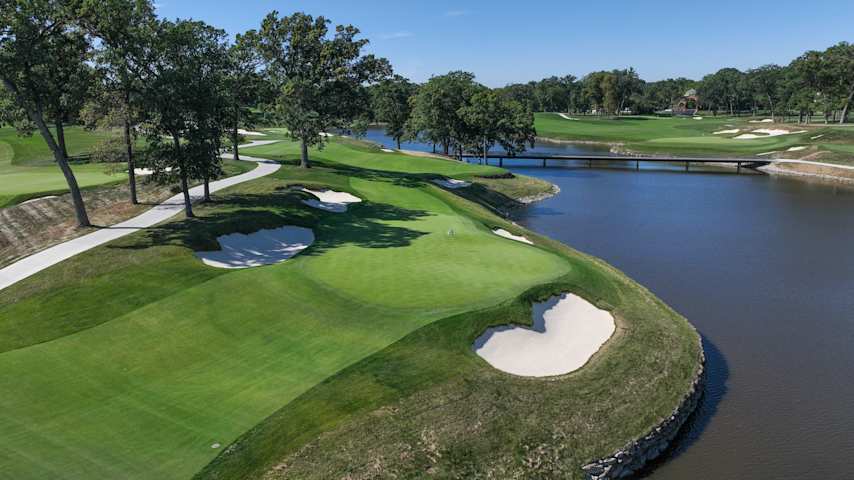
A drone shot of the par-3 13th hole for the 2026 Presidents Cup at Medinah Country Club, Course No. 3, in Chicago, Illinois. (Photo by Quinn Harris/PGA Tour)
Medinah Country Club, Course No. 3
| Hole | Par | Yardage |
| 1 | 4 | 505 |
| 2 | 4 | 476 |
| 3 | 5 | 582 |
| 4 | 4 | 373 |
| 5 | 4 | 479 |
| 6 | 5 | 646 |
| 7 | 3 | 209 |
| 8 | 4 | 510 |
| 9 | 3 | 153 |
| 10 | 4 | 455 |
| 11 | 4 | 514 |
| 12 | 4 | 402 |
| 13 | 3 | 217 |
| 14 | 4 | 487 |
| 15 | 4 | 436 |
| 16 | 3 | 211 |
| 17 | 4 | 430 |
| 18 | 4 | 479 |