



Nine things to know: Aronimink Golf Club, host of 2026 PGA Championship
9 Min Read
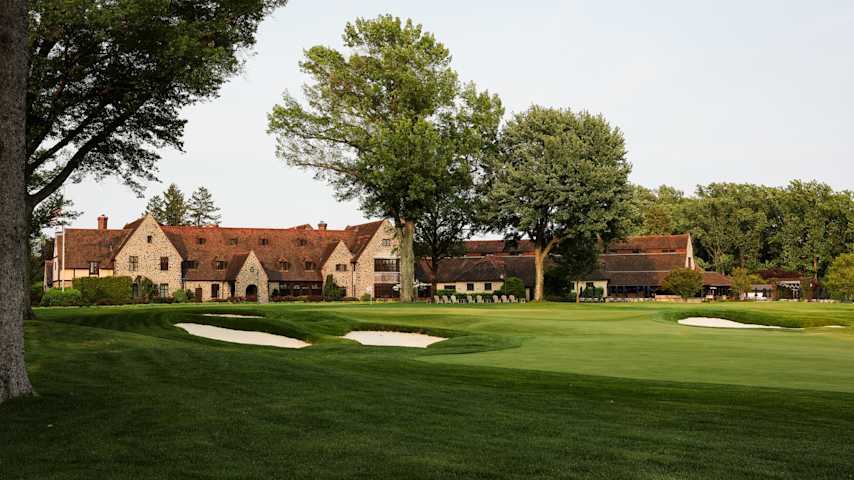
A view of the clubhouse from the 18th hole at Aronimink Golf Club. (Scott Taetsch/PGA of America)
The 108th PGA Championship returns to the historic Aronimink Golf Club, just outside Philadelphia, for the first time since 1962.
Read about the Donald Ross-designed course's origins, history and legacy.
1. Philly strong
Metro Philadelphia rivals Long Island, Eastern Scotland and Greater London when it comes to a concentration of great golf courses.
Aronimink Golf Club, home to the 2026 PGA Championship, shares top-100 billing with the likes of such regional luminaries as Pine Valley Golf Club, Merion Golf Club and The Philadelphia Cricket Club's Wissahickon Course, with Gulph Mills Golf Club, Huntingdon Valley Country Club, Lancaster Country Club, Lehigh Country Club, Manufacturers’ Golf and Country Club, Philadelphia Country Club, Rolling Green Golf Club and Stonewall Links' Old Course very close behind.
In part, the terrain and well-draining soils are conducive to golf, but so is a genealogical tradition of great architects who were born and bred there and whose influence radiated out through the golf world to spawn the Golden Age of Architecture. Chief among them were William Flynn, George Crump, George C. Thomas Jr., A.W. Tillinghast, Howard Toomey and Hugh Wilson. The result is one great course after another, many of them still serving as championship venues today.
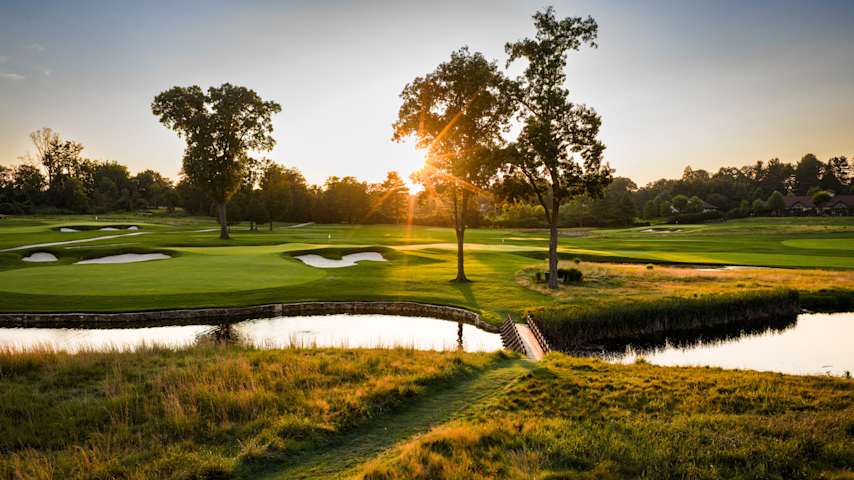
A scenic view of the eighth and 10th green at Aronimink Golf Club. (Dave Evenson/PGA of America)
2. Aronimink history
The club, named after the leader of the local Native American Lenape tribe, dates to 1896. After several moves, it arrived in 1928 at its current site in the west Philadelphia suburbs, 13 miles from downtown.
The club’s distinguished history, including founding membership in the Golf Association of Philadelphia, includes several significant championships:
- 1962 PGA Championship: Won by Gary Player, the first of his two PGA Championship victories (1972); he's still the only South African to win this championship.
- 1977 U.S. Amateur: Won by John Fought, who prevailed 9 & 8 in the final and then went on to the PGA TOUR, where he won two tournaments and Rookie of the Year honors in 1979.
- 1997 U.S. Junior Amateur: Jason Allred defeated future PGA TOUR star Trevor Immelman. Allred, now an assistant golf coach at his alma mater, Pepperdine University, went on to record 70 PGA TOUR starts and 152 on the Korn Ferry Tour.
- 2003 Senior PGA Championship: Won by John Jacobs to cap off a distinguished career that saw him triumph five times on PGA TOUR Champions.
- 2010/2011 AT&T National: Won by Justin Rose in 2010, followed by Nick Watney in 2011, after Watney shot a course record 8-under 62 on Saturday.
- 2018 BMW Championship: Keegan Bradley showed how good these guys really are when he eked out a playoff victory over Rose in the third leg of the 2018 FedExCup Playoffs. Bradley’s 20-under 260 total emerged from rounds of 66-64-66-64.
- 2020 KPMG Women’s PGA Championship: Won by South Korea’s Sei Young Kim with a tournament record 14-under par score of 266, capped off by a final-round 63 that sealed her five-shot victory.
3. Donald Ross
Ross, 1872-1948, came out of the Scottish Highlands to the U.S. in 1899 and transformed the American golf landscape with over 410 designs. That includes new courses, renovations and expansions of existing nine-hole layouts. For all the accolades his work at such projects as Oakland Hills Country Club (Michigan), Oak Hill Country Club (New York), Pinehurst Resort (North Carolina), Scioto Country Club (Ohio) and Seminole Golf Club (Florida) garnered, he famously observed at the end of his life upon revisiting Aronimink that, “I intended to make this course my masterpiece, but not until today did I realize I built better than I knew.”
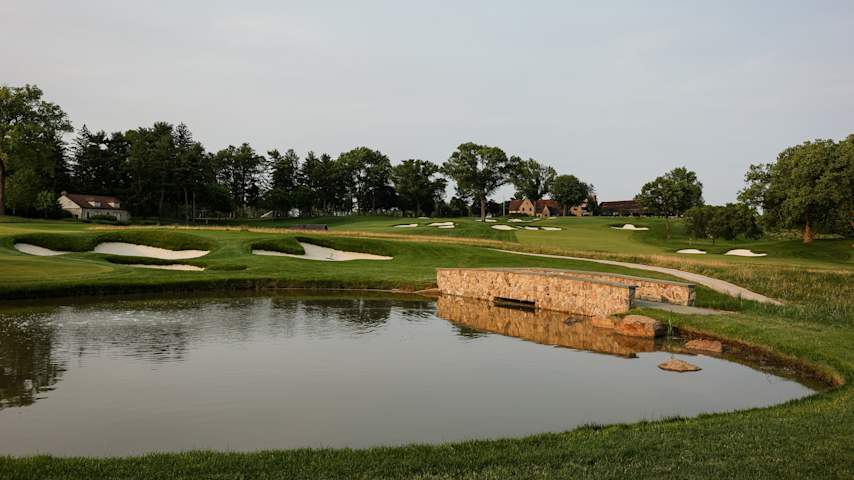
A look at the lengthy par-3 17th hole at Aronimink Golf Club. (Scott Taetsch/PGA of America)
We know Ross spent time on site during construction because he appears on a segment of a precious 8mm film made at the time documenting the work and showing how rough the conditions of course building in that era: hand saws, wheelbarrows, draft animals pulling shaping equipment, a few trucks, lots of dust from dynamite and deep trenchers installing irrigation pipe on what had been heavily wooded land. The course was hacked by hand saw. It forms a sobering reminder of the labor that went into creating great golf – not just the craftsmanship but also the sweat and long hours required.
Out of such conditions, Ross could envision the shots he saw as testing a fine golfer: long irons, as well as recovery around artfully sculpted greens, and the need to place tee shots in fairways while tacking left and right to avoid bunkering along the way. The emphasis was less upon power than upon deft shot-making and shaping so that golf balls didn’t just land where intended but came to a rest in an advantageous position. What Ross learned from his mentorship at St Andrews Links under Old Tom Morris was the value of keeping the golf ball in play and thinking ahead, as if playing chess or tacking one’s boat into safe harbor.
4. Bunkers
Ross’ design work derives from an era when bunkers were still considerable hazards. The clubs used to extricate from bunkers did not (yet) have bottom flanges and so did not qualify as sand wedges. Bunkers were unraked during normal play. The lie you got was totally unpredictable, and there was no expectation based on modern notions of “fairness” that if trapped, you'd be able to hit a full recovery to the green. You took your punishment and whimpered on.
Uncharacteristically for Ross’ designs in those days, his plans for Aronimink were not drawn with much bunker detail. For that relied upon the club’s green chairman to implement the day-to-day construction – and with good reason, because the club officer was none other than Ross’ own longtime design associate, J.B. McGovern. Ross obviously was looking in enough to approve the decision to scatter some 175 bunkers across the site – a considerable departure from Ross’ work elsewhere at the time, and suggestive that he was content to make Aronimink unusually demanding. Detailed aerial imagery from the 1930s confirms the vast extent of bunkering that would define Aronimink for decades.
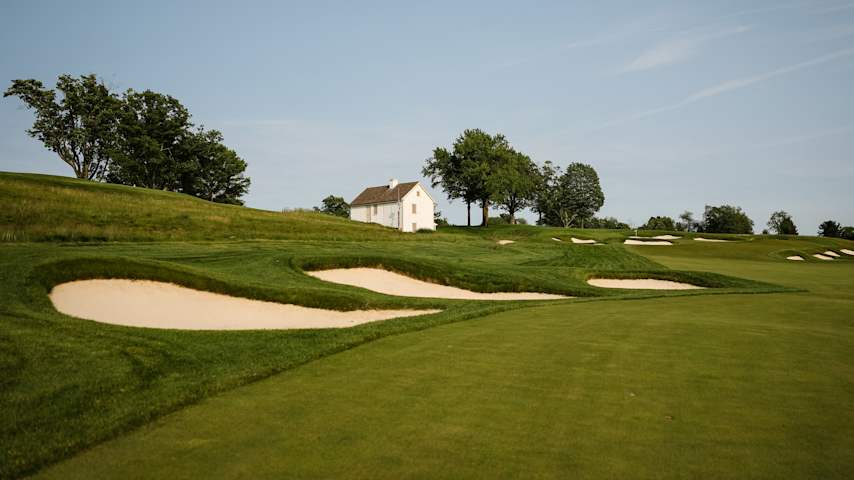
A look at the par-4 11th hole at Aronimink Golf Club. (Scott Taetsch/PGA of America)
In the 1950s through the 1980s, the club went through extensive design simplification, with bunkers removed, trees overplanted, fairways narrowed, and the course robbed of its founding character. It took an initial restoration effort by Ron Prichard in the mid-1990s to begin the return of Aronimink’s distinctiveness. The process took another major step in 2016-17 under the direction of restorationists Gil Hanse and Jim Wagner, who based their work upon the older photos and the conviction that the club’s future lay in its past. The bunker expanse more than doubled. What had been 74 bunkers totaling 96,000 square feet became 174 bunkers comprising 200,000 square feet.
5. Greens
Everything about Aronimink is on a big scale. The golf course occupies the center of a 300-acre site. The holes traverse rolling land that tips and slides and is in constant motion. And the putting surfaces convey so much pitch and yaw that if care is not exercised in the placement of hole locations, players will find it hard to get their ball to roll along an intended line.
The greens, too, are big – on average, 8,100 square feet, which is about a third bigger than most greens on courses designed by Donald Ross. The latest round of restoration by Hanse and Wagner a decade ago saw the greens get 25% larger after rebuilding – enough to recapture lost peripheral hole locations and to tie the putting surfaces back into those framing bunkers and the surrounding fall-offs of the fill pads.
For the PGA Championship, they will be mowed down to within 1/10th of an inch of their life and rolled (or pressed) so that they are as smooth as glass and nearly as fast, in the range of 13.5 on the Stimpmeter, unless heavy rains or winds threaten to upset the firm conditions planned for the event.
With greens this large, and with so many back corners protected by adjoining bunkers, fall-offs and short grass roll-outs, it makes a big difference to playing strategy from day to day, where the hole is cut.
6. Grinding par 4s
The substance of Aronimink, 7,394 yards, par 70, is its par 4s. They are consistently demanding, each one (after the opening hole) entailing a change of direction as you approach the tee so that you never get comfortable with wind direction, and each one on terrain that varies in terms of elevation, slope and side tilt. They are all well bunkered in the drive landing zone, with the ideal line into the green usually the one most heavily defended. Fairways vary widely in width, with landing areas as wide as 50 yards and as narrow as 20, depending upon terrain, length of approach and how heavily or lightly the putting surface is protected.
The back nine amps up the challenge. The par 4s on the front average 432 yards; on the back nine, 464 yards. That means a full two-club difference in approach irons, a considerable difference under tournament pressure.
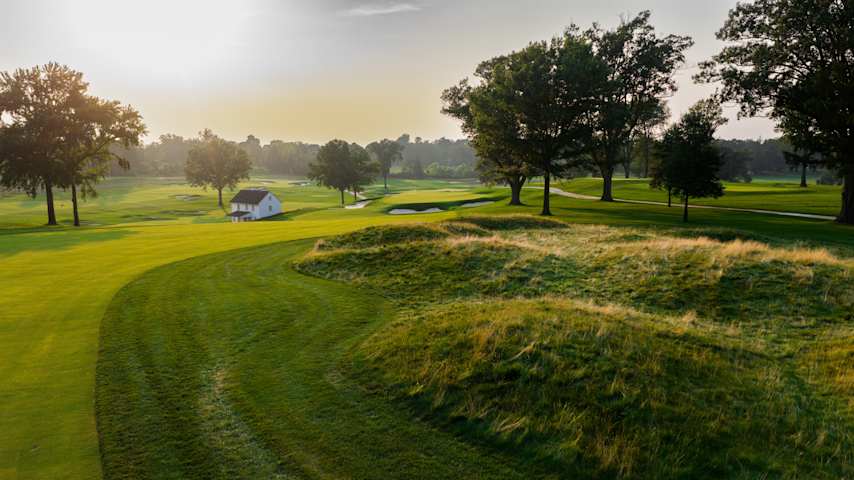
A look at the par-4 seventh hole at Aronimink Golf Club. (Dave Evenson/PGA of America)
It will be crucial to hit fairways off the tee. This is not “bomb and gouge” golf, where distance alone is a virtue. That’s because it will be imperative to control the spin on approach shots, something much easier to do from fairways cut at 3/8ths of an inch (0.375 inches) than from 3 1/2-inch-deep fescue/bluegrass rough. That’s an all-or-nothing proposition, since there is no forgiving intermediate rough immediately alongside fairways; the transition from tight cut to rough cut is immediate. Golf balls running out on the low side find grass that is especially “juicy” – thick and heavy, due to the accumulation of irrigation runoff and fertilizer on that side. If that seems unfair, too bad. No one said championship golf is an exercise in equity. Miss a fairway, and you’ve got an issue to deal with.
7. Hole to watch: 171-yard, par-3 fifth
Every Ross course features a devilish short par 3, usually one surrounded by sand. The theme is apparent, as with Oakland Hills’ 14th, Scioto’s ninth, Wannamoisett’s third, Oak Hill's fifth, and now this one, tucked into the southern corner of the property. Like its brethren, the fifth has a bit of a swale in the middle, with a higher tier around and behind it, and the entire green is fronted by steep bunkers that obscure the depth of the putting surface.
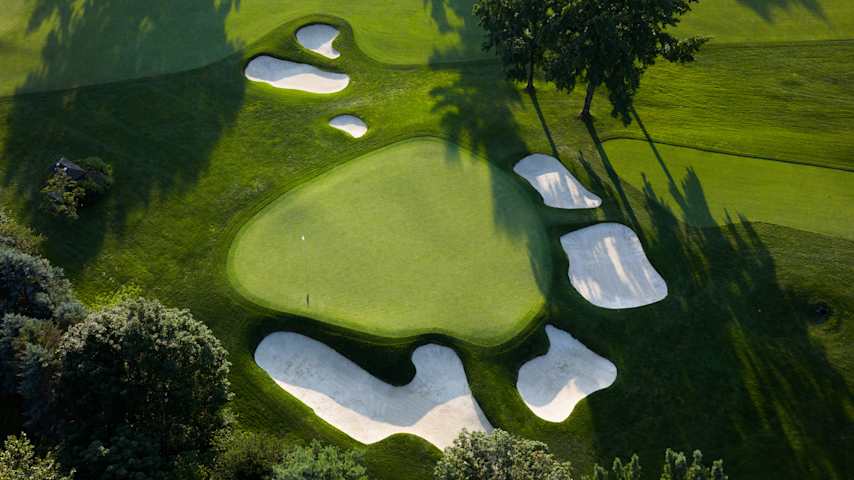
A top-down view of the signature Donald Ross style green complex at the par-3 fifth hole at Aronimink Golf Club. (Dave Evenson/PGA of America)
For these players, it’s an 8- or 9-iron on the tee, but the controlling thought is to carry the sand without hitting it over the green. When golfers have two contrasting shot thoughts in their heads, a bit of uncertainty can emerge. Ross, very much the amateur psychologist, knew that very well.
8. Hole to watch: 385-yard, par-4 13th
The shortest par 4 on the course is simply ingenious for its strategic demands. The key is a fairway bunker complex left center, 260 yards to reach, 285 to carry. The driver needed to clear the bunkers, bringing out-of-bounds tight on the left into play; it also would leave one with a short little flip wedge into the green to a well-defended green where spin and control are paramount. Better to lay back off the tee with an iron and approach the putting surface with a fully struck short iron or wedge.
For this PGA Championship, tournament officials have installed a forward tee that allows the hole to play 285-290 yards long, within range of everyone in the field, even if with less than a driver. The beauty of such a foreshortened hole is that it brings lots of risk into play, including that out of bounds left and a stand of trees right. At least once during the weekend, and perhaps once during the first two rounds as well, the 13th will be set up as drivable. It should make for very exciting play, and certainly the only relatively clear birdie opportunity of the last six holes.
9. Hole to watch: 490-yard, par-4 18th
This is one of those grind-it-out finishing holes where golfers need to hold on for dear life. The hole climbs 30 feet from tee to green, with a property line and out-of-bounds down the left side and the right side of the landing zone protected by a deep bunker complex and trees.
A new back tee added for the PGA Championship will rule out players carrying those fairway bunkers as they could in 2018 – it’s now 340 yards uphill to clear. That means they will be coming into the amphitheater green from 170 to 210 yards out. All the more pressure to hit the fairway off the tee.
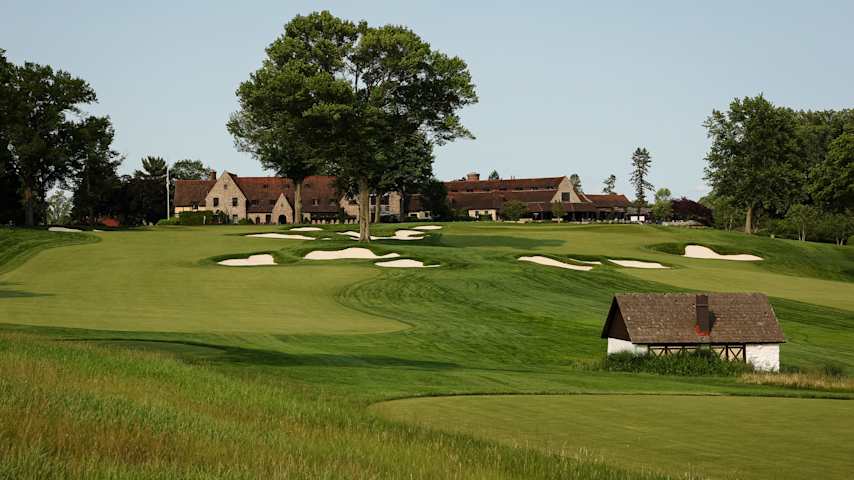
A general view of the 18th hole and the iconic cottage at Aronimink Golf Club. (Scott Taetsch/PGA of America)
The setting here, with the hole ambling up to in front of the club’s Tudor-style clubhouse, evokes the kind of classic parkland setting that defines a powerful tradition of American championship golf.
Aronimink Golf Club scorecard
| Hole | Par | Yardage |
| 1 | 4 | 434 |
| 2 | 4 | 413 |
| 3 | 4 | 455 |
| 4 | 4 | 457 |
| 5 | 3 | 171 |
| 6 | 4 | 402 |
| 7 | 4 | 431 |
| 8 | 3 | 242 |
| 9 | 5 | 605 |
| 35 | 3,610 | |
| 10 | 4 | 472 |
| 11 | 4 | 425 |
| 12 | 4 | 466 |
| 13 | 4 | 385 |
| 14 | 3 | 216 |
| 15 | 4 | 546 |
| 16 | 5 | 555 |
| 17 | 3 | 229 |
| 18 | 4 | 490 |
| 35 | 3,784 | |
| 70 | 7,394 |


