



The putts that fool Masters champions
8 Min Read
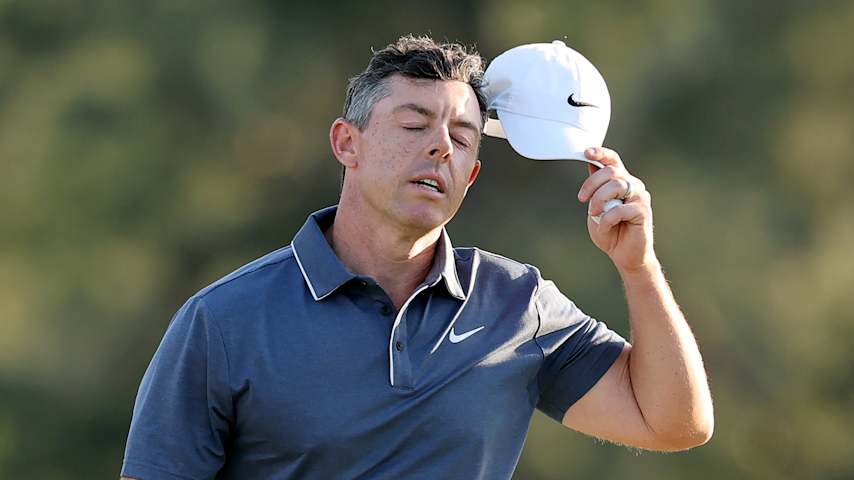
Rory McIlroy reacts to missing a par putt on the 18th hole during the final round of the 2025 Masters Tournament. (Michael Reaves/Getty Images)
Players in Article
Players in This Article
AUGUSTA, Ga. – Rory McIlroy stood 5 feet from salvation.
Five feet from euphoric relief that would usurp 14 years of heartbreak. Five feet from historical glory that would place McIlroy’s surname among the deities of the sport. All that was left was a gentle right-to-left par putt on the 18th green at Augusta National.
It was a putt McIlroy had watched numerous would-be Masters champions make and countless nearly-were champions miss. An avid historian of the game, McIlroy noted that players too often missed putts on the high side. It’s an innocuous enough detail to notice while watching highlights on the couch, until you’re standing over the same putt to win the Masters and have to decide what to trust: your feels or your memories.
Fearing he may repeat the same fate that befell so many others, McIlroy played slightly less break than he saw with his eyes. Remember, he told himself, everyone tends to miss this high. Instead, the putt dove on him, falling left, missing the hole and sending McIlroy’s Masters Sunday that would never end into a playoff.
“I should have went with my first instinct,” McIlroy said recently, a sentiment he could laugh off now because he trusted his eyes in the playoff, holed his 3-foot birdie putt on the first playoff hole, won the Masters and became the sixth man to win the career Grand Slam.

Rory McIlroy after his winning putt on the 18th green at Augusta National in the 2025 Masters Tournament. (Ben Jared/PGA TOUR)
McIlroy’s observation shouldn’t go unnoticed, though. Within it lies a secret magic of Augusta National and the Masters. A phenomenon born of endless highlights, frequent pre-tournament visits and a rabid media obsession with a tournament that transcends the golf world.
Every hole is endlessly dissected and easily recalled. It’s what makes the Masters, the Masters. There’s a connective tissue of memories that can be called upon on command. It’s true for patrons, but it’s visceral for the players who create those memories. It is said that experience is invaluable at Augusta National. Nobody will deny it, but with experience comes a loss of innocence – an over-indexing on information that can make you second-guess what might be there. Every added data point brings a layer of comfort layered on top of more indecision – a maddening cocktail that sets the Masters apart.
“I've always said it'd be kind of nice to kind of push reset and just, you know, almost erase some of the memories and feelings you have,” said Zach Johnson, 2007 Masters champion. “I say that, but I don't want to actually do that.”
The first piece of advice that Masters veterans give to first-timers is always to be cognizant of the property's low point. That’s easy to do because it’s also the most famous spot on the course: Amen Corner. Augusta National sits upon a dramatic parcel of land that slopes heavily from north to south. The highest point of the course is near the clubhouse, and the congregation of the first and 10th tees and the ninth and 18th greens. It’s all downhill from there, with the low point near at the 12th green. Broadly, everything wants to move that way. Fairways slant toward Amen Corner, and putts just want to veer down toward the hallowed creek.
“You always have the low point of the golf course in mind,” said Trevor Immelman, 2008 Masters champion.
But with that comes a set of expectations that aren’t uniform. McIlroy’s 18th hole putt in regulation is a perfect example. While the putt does break toward Amen Corner, the Sunday pin is tucked in a swale, just behind a large hump that rejects balls that come up short. Its presence does just enough to keep some putts higher than expected, leading to the misses McIlroy watched so often. McIlroy tried to take that into account and got burned.
“One of the beauties of our sport is all you need is just a little seed of doubt to cause absolute havoc in your game,” Immelman said. “And you know Rory would have had so many different thoughts running through his mind at that point, knowing that that putt was for the green jacket and all the pressure that comes along with that.”
That pin position has become famous for its fickleness. In 1998, David Duval held the clubhouse lead and was sitting in Jones Cabin watching fellow co-leader Mark O'Meara play the 18th. O’Meara hit his approach shot 20 feet right of the pin. “Don’t worry, David, no one ever makes that putt,” said Augusta National’s then chairman, Jack Stephens.
Instead, O’Meara buried it to win.
With the prompt of picking the green that still flummoxes him this many years into his Augusta National career, Johnson pointed to the 17th, which he often believes will defy the low point theory. The way that the green site sits visually, the right side appears higher than the left. When the pin is on the top-right shelf, players will often play just over the right bunker, but short of the highest tier, as a miss long is the surest route to disaster. But that specific putt from below the hole has never agreed with Johnson.
“It looks like everything on the right side of the green is sitting up so that it should, if you're below the hole, it should break right to left,” Johnson said. “Well, it does anything but that. It still goes left to right.”

A view of the first green (left) and fifth green (right) at Augusta National. (Ben Jared/PGA TOUR)
Johnson also pointed to the first-, fifth- and seventh-hole green complexes that will consistently puzzle him. The seventh puzzles him with its subtlety. The green can look flat at many points, but putts often break in ways he wasn’t expecting. The first and fifth are the opposite, with slopes so severe that the challenge is all in the pace, not the reads.
“You accumulate so much knowledge there, so much experience and wisdom by hitting shots, putts, things of that nature that you're like, 'Okay, I know this breaks more than that. I know the grain takes this to Amen Corner,' or whatever it may be, and you can get caught up in that too much rather than just kind of seeing and feeling, seeing what your eyes see, playing that, feeling what your feet play, playing that,” Johnson said.
Mike Weir, 2003 Masters champion, has found the fourth green to be most difficult to judge, particularly the back-left section, which is elevated on a hump. The intricacies of the breaks, particularly when putting from a different tier, have proven arduous.
“There's no other golf course in the world that you have to match speed and line to make a putt as perfectly as Augusta,” Weir said. His other big pain point is the middle-back pin on the 15th, often the Sunday pin. “If you're dead on, putting straight up the hill, it ends to break to the right. If you're just off the center, it can do a number of different things.”

A view of the 16th green at Augusta National. (Ben Jared/PGA TOUR)
The 2016 Masters champion Danny Willett joined Johnson in his assessment of the fifth green, which Willett believed to be the hardest on the course. He’s also found the 16th green tricky, particularly a year ago, after the green was redone following the impacts of Hurricane Helene. That was a forced re-do, but Augusta National is notorious for making changes. Some they let the public in on; others they do quietly, letting competitors figure it out (or not) on their own. Willett believes Augusta National re-sodded the 16th again ahead of this year, too.
It’s another added wrinkle in solving Augusta National. Just as you thought you had a handle on how certain putts break, the club makes the subtlest of tweaks that sends you back into problem-solving mode.
To be clear: Augusta National isn’t making the changes to fool anybody. It’s standard practice for them to lay new sod on three or four greens every year. Sometimes they remain a carbon copy of the year before, and other times they are tweaked slightly in size or with specific slopes to maintain the ideal strategic effect. Players will often find out about changes either through official communication from the club or through offhand comments from members during practice rounds.
Sometimes, though, they don’t have any notice.
“They keep sneaking around things,” Willett said. “We've all got notes that we've taken, obviously, over the last decade. So it's a constant game of– it's tricky when you've played it loads and you've had similar putts to like, right, this is definitely a cup out or two cups out. And then you get there and actually hit that and it doesn't quite do the same.”
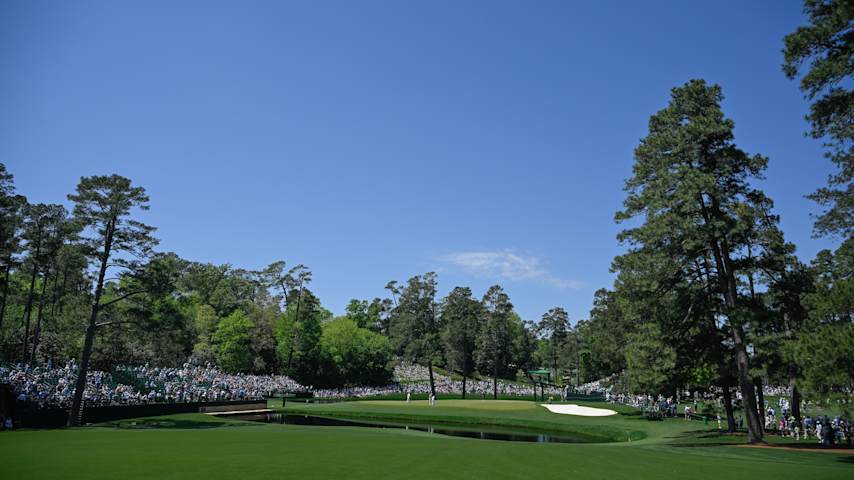
A view of the 15th green at Augusta National. (Ben Jared/PGA TOUR)
The 15th hole was one of the greens that was re-sodded ahead of 2025, and it played a major role in the first round of the event. New greens, because of the youth of the grass, are often much firmer than greens that have remained the same for years. That leaves them bouncier on approach shots and more difficult to control the spin on short-game shots. McIlroy fell victim to that on Thursday. His second shot bounded off the back of the green and his pitch shot didn’t grab how he expected, running off the front of the green and into the water, leading to a disastrous double bogey.
“I've hit that chip a hundred times around this golf course -- it was just more the first bounce was so firm. I mean, that green is so much firmer than any other green, even the other -- the three newer greens,” McIlroy said.
It’s the not-so-secret thing about Augusta National. For as rooted in tradition as the course and tournament are, it’s also one of the most evolutionary. With seemingly unlimited resources and a clear edict to maintain the event’s prestige, it’s constantly evolving. Augusta National, more than any other course, is a living, breathing document.
Nobody will ever master the Masters.


