Looking back on Arnold Palmer's career-changing first victory at 1955 RBC Canadian Open
4 Min Read

In his 21st start of his rookie season, Arnold Palmer picked up that first elusive win that turned out to be a jumping-off point to a remarkable PGA TOUR career at the 1955 RBC Canadian Open. (Credit Golf Canada)
Arnold Palmer's putative Hall of Fame professional golf career took a detour in 1950 when his best friend and Wake Forest golf teammate, Marvin Worsham, who Palmer called Bud, and another pal, Alfred Sheer, died in a car accident on the Neuse River Bridge in North Carolina. The deaths shook Palmer, an All-American Demon Deacon golfer, that he withdrew from school with only a semester remaining until graduation and joined the Coast Guard.
From January 1951 until early 1954, Palmer went through basic training in New Jersey, then worked in Cleveland and Connecticut, played a little recreational golf and resisted the opportunity to attend Officer Candidate School.
Palmer still wanted to play golf professionally and wasn’t planning on making the Coast Guard his career.
Upon discharge, Palmer returned to Winston-Salem, North Carolina, finished his course work at Wake Forest, married Winifred Walzer, made a little money working for a few months for Bill Wehnes, a paint manufacturer’s representative, and then set his sights on turning pro sometime after that year’s U.S. Amateur at the Country Club of Detroit.
Palmer walked away with the USGA hardware in the Motor City, taking down Robert Sweeny, 1-up, in the final match in late August. By that point of the year, Palmer had already played in four PGA TOUR events as an amateur, tying for seventh at the Azalea Open in March and posting ties for 14th and 24th, respectively, at the All American Open and the World Championship of Golf, both played in consecutive weeks at Tam O’Shanter Club outside Chicago. A week later, his valedictory came at the U.S. Amateur. By November, he had turned pro, and that was that for amateur golf.
So, by the time Palmer made it to Weston Golf Club in suburban Toronto for the 1955 RBC Canadian Open, Palmer had appeared in 20 tournaments as a pro, missing only one cut (Kansas City Open). He also had top-10s at the Valero Texas Open (tied for sixth) and ties for 10th at both the WM Phoenix Open and the Masters.
In his 21st start of his rookie season, Palmer picked up that first elusive win that turned out to be a jumping-off point to a remarkable PGA TOUR career.

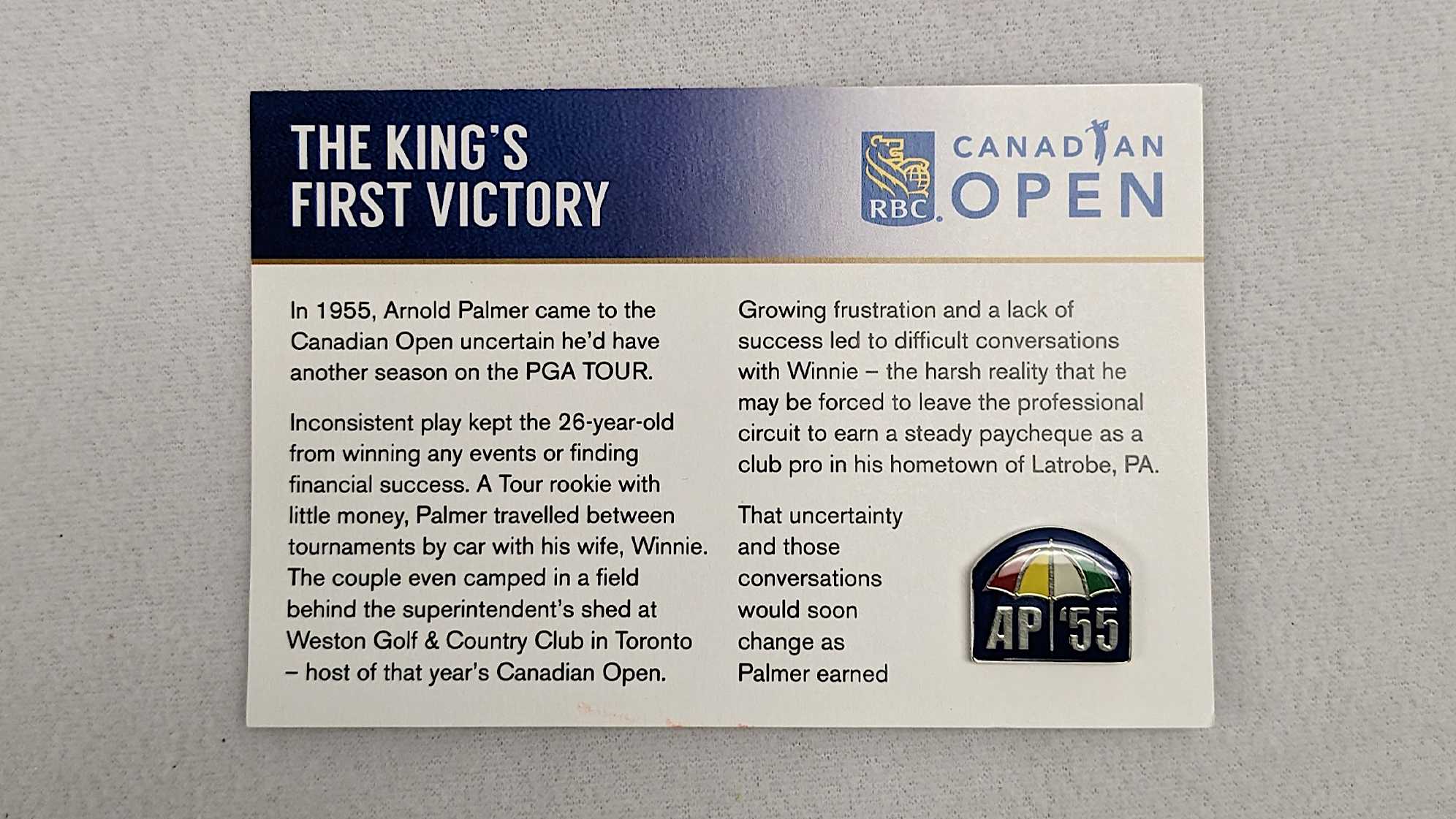
The Coast Guard veteran – writers alternated between describing him that way, as “the Wake Forest All-American” and as “the U.S. Amateur champion”– opened with an 8-under 64 but trailed Charlie Sifford by a stroke. His follow-up 67 gave Palmer a two-shot advantage over Jack Burke Jr., at the halfway mark of the Wednesday-to-Saturday national open. Palmer basically salted things away in the third round, shooting his second 64 of the week to take a five-stroke lead over Burke into the final 18 holes.
Veteran Tommy Bolt, alone in fifth, eight shots back and Palmer’s third-round playing partner, was a 10-time PGA TOUR winner to that point in his career, with three of those victories coming in 1955. He chuckled when asked if he thought anybody was going to chase down the young Palmer.
“The only way anyone will catch him is for Arnold to break a leg,” Bolt said.
Burke had seen Palmer in action at various PGA TOUR stops that season and previously, when Palmer was an amateur, and too, sounded resigned to the inevitability of a Palmer triumph.
“He’s got an amazing touch with his putter,” said Burke, the 1956 Masters and PGA Championship winner. “He used to be a little wild off the tee, but this course is just built in his style with those wide fairways.”
Over the closing 18 holes, Palmer had his first big misstep of the week when he made a double bogey at No. 5, following an errant drive into the bushes. Fred Hawkins began the final round seven behind Palmer, and he immediately put pressure on the Latrobe, Pennsylvania native, going par-birdie-eagle-birdie to start his day. Palmer righted things at the par-5 seventh, reaching the green in two. He just missed his 9-foot eagle putt but tapped in for birdie, with Hawkins only making par there. Another Palmer birdie, at the ninth, restored his five-shot cushion as he made the turn, and from there he coasted to a four-shot defeat of Burke, with Hawkins five back. The coveted Seagram Gold Cup was Palmer’s.
Meeting with the media following the win, Palmer calmly explained his strategy as the leaderboard tightened. “I always make a rule to play the course rather than my opponent,” he said matter-of-factly. “I did the same thing when I won the Amateur, and that was match play. I just keep shooting and hoping to play the best I can.”
Sixty-one TOUR victories, in addition to his RBC Canadian Open triumph, would suggest that Palmer’s plan seemed to work out OK.