




Before Brooks vs. Bryson, a look at the history of golf’s rivalries
7 Min Read
After a riveting 36 holes of head-to-head golf in the 1977 Open Championship in which Tom Watson played the final two rounds at Turnberry in 65-65 to defeat Jack Nicklaus by one stroke, the desire for future drama between the rising star and the enduring legend was quickly voiced.
“It looms as a golf version of a barroom brawl,” the Associated Press’ Will Grimsley wrote from Scotland. “It should well develop into one of the classic sports rivalries of the century. It can be Rocky Graziano and Tony Zale all over again, Muhammad Ali against Joe Frazier, the Yankees and Dodgers in a revival of the baseball feuds of the 1950s.”
Grimsley can be forgiven for his excited typing in the wake of the “Duel in the Sun,” as the ’77 Watson-Nicklaus showdown came to be known. Imagine Secretariat sprinting toward the finish of the 1973 Belmont Stakes but with another horse next to him that he couldn’t shake. Nicklaus finished second by a stroke but was 10 shots clear of third-place Hubert Green. In the same country where the earliest professionals made their mark playing ballyhooed money matches against each other during the 19th century, Watson and Nicklaus, in a late-20th century Open, had closed off opportunity for all others, turning medal play into a de facto match.
“No matter what else Tom Watson would ever do in golf—and he would do much more—history had embraced him now,” Frank Deford wrote in Sports Illustrated nearly a decade later, “for he had beaten the best at his best, best to best.”
Epic. Rare. Epic because such battles are rare.
Grimsley, who for decades went from stadium to court to ring as a sportswriter covering foes familiar to one another and those watching, didn’t get his wish because rivalries are golf’s mostly unrequited desire, more mirage than reality. Watson and Nicklaus didn’t go anywhere over the next five summers, but Turnberry remained a singular plot. In the 1982 U.S. Open at Pebble Beach, Watson broke through in the national championship while breaking Nicklaus’ heart with a 71st-hole chip-in. In contrast to Turnberry, however, Nicklaus already was off stage, having completed his round when the man who supplanted him as No. 1 in the game executed the amazing shot from deep grass, the way it usually goes in golf.
From the 1977 Masters through the 1982 U.S. Open, a span of 22 major championships starting with Watson’s narrow victory over Nicklaus at Augusta National and concluding with the same outcome at Pebble Beach, Watson accumulated five majors and had five additional top-five finishes; Nicklaus won three majors and had nine top-fives. Each player was in contention a lot when it mattered in that handful of years, a crucial ingredient in facilitating a legitimate golf rivalry. And even then, despite their leaderboard presences, 20 majors were played before an event again was compressed into something akin to a title fight.
This week’s match between Bryson DeChambeau and Brooks Koepka in Las Vegas—a made-for-television encounter between two current stars whose competitive tension has largely existed outside the ropes on the course of social media —occurs in the context of this golf history. Golf fans crave, savor and hype rivalries because the dynamic makes for compelling competition and, to Grimsley’s point, helps golf resemble other sports in rivalries are part of a regular diet, and not just a delicious treat.
The notable rivalries in men’s golf have tended to develop when players are winning at roughly the same clip during the same time—in three eras, three players, not two, were involved. This certainly was true of “The Great Triumvirate” shortly before and after the dawn of the 20th century. Harry Vardon, from the Isle of Jersey, Scotsman James Braid and Englishman J.H. Taylor achieved remarkable success in The Open Championship. From 1894 through 1914, Vardon won six times with Braid and Taylor claiming five titles apiece. The five years in that span that one of the three didn’t win the Claret Jug, one or more members of the trio finished second.
Throughout the 1920s, dominant American amateur Bobby Jones and leading U.S. professional Walter Hagen each filled newspaper sports sections with their exploits. Because of their different stations in golf—amateur and pro—head-to-head play was limited.
Hagen won his two U.S. Opens (1914, 1919) before Jones played in his first. In two of Jones’ three Open Championship victories (1927, 1930), Hagen wasn’t in the field; Jones didn’t compete in two of Hagen’s Open wins (1928, 1929). Hagen wasn’t a factor the four times Jones won the U.S. Open. Promoters created a “Battle of the Century” 72-hole match between the two headline-makers in early 1926, but it fizzled as Hagen routed Jones, 12 and 11. The theater of that season came in The Open at Royal Lytham & St. Annes. Jones, with the clubhouse lead, looked on as Hagen, trailing by two strokes, played the last hole. Ever the showman, Hagen paced off the mashie approach he needed to make to force a playoff. After making it back to his ball with the anticipation building, he landed his shot within inches of the cup before watching it scuttle over the putting surface. His chance at victory gone, Hagen took four to get down and tied for third place, four behind Jones.
The triumvirate of great American golfers born in 1912—Ben Hogan, Byron Nelson and Sam Snead—started battling in the mid-1930s. Nelson retired from fulltime competition following the 1946 season, but Hogan and Snead remained on the stage much longer. Snead defeated Hogan in a playoff at the 1954 Masters in their last head-to-head contest at a major. Their many victories—Snead, 82 TOUR wins including seven majors; Hogan, 64 wins, nine of them majors; Nelson, five majors among 52 titles—kept them in the golf consciousness for a long time.
It was much the same for “The Big Three,” the modern game’s incarnation of a dominant group of three rivals. As with Hogan, Nelson and Snead, Nicklaus, Arnold Palmer and Gary Player won often and when it mattered most, building a wealth of memories for themselves and those watching.
Despite deepening competition compared to earlier eras, during a 21-year period beginning with the first professional major title won by Palmer at the 1958 Masters victory and running through 1978, Nicklaus, Player and Palmer combined for 31 victories in the 84 majors contested. Seventeen additional times one or more of The Big Three finished second in a major, giving them first or second in a major 57 percent of the time. Even so, head-to-head duels were infrequent.
Nicklaus defeated Palmer in a playoff at the 1962 U.S. Open at Oakmont, a triumph that signaled he was an imminent threat to Palmer’s reign. They were paired together over the final 36 holes at the 1967 U.S. Open at Baltusrol, Nicklaus again getting the best of Palmer. It was another 5½ years before they played together in a final round with everything on the line. At the 1973 Bob Hope Desert Classic, Palmer outplayed Nicklaus to win his 62nd and what turned out to be final PGA TOUR victory.
By that point Nicklaus was well into a legitimate rivalry with another man who would become a Hall of Famer. From 1968 through 1974, Lee Trevino matched Nicklaus’ five major victories with Trevino challenging closely in two of those (T-3, 1970 Open Championship, T-4, 1972 U.S. Open). But what defined this rivalry beyond the distinctive styles of the two golfers was that Trevino had to overcome Nicklaus, who was runner-up four times to him in this span: 1968 U.S. Open; 1971 U.S. Open in a playoff; 1972 Open, where Nicklaus was going for his third straight major title; 1974 PGA Championship. (Although five strokes behind, Nicklaus also was T-5 at Trevino’s 1971 Open Championship victory.)
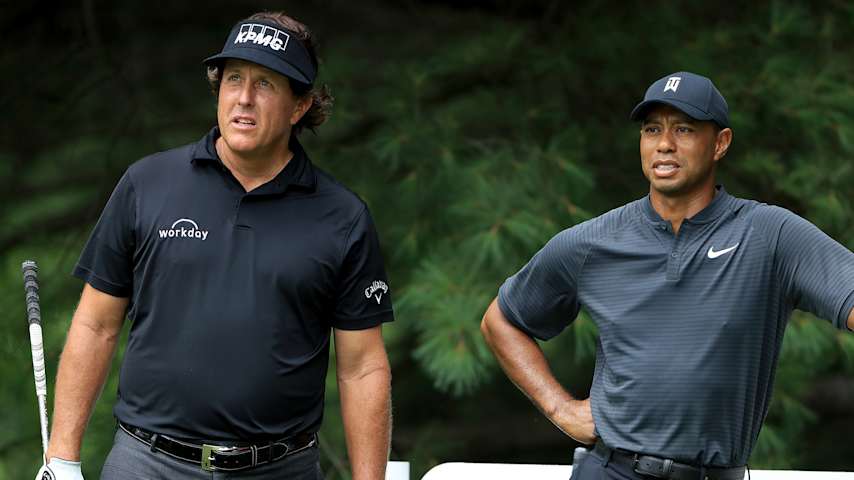
In the quarter-century that Tiger Woods and Phil Mickelson have been on TOUR together, fans have yearned for more head-to-head confrontations. As with headliners of previous generations, though, such occasions have been relatively infrequent. Mickelson was paired with Woods in the fourth round of the 2001 Masters with the “Tiger Slam,” four consecutive major victories, in the balance. Woods outscored Mickelson, 68-70, to edge David Duval by two with Mickelson finishing third, three shots back.
The two legends haven’t been in a final-round major pairing since that monumental day when Tiger made history, but they have played alongside one another seven times in final rounds on TOUR. Woods (2003 Buick Invitational, 2005 Ford Championship at Doral), and Mickelson (2007 Deutsche Bank Championship, 2012 AT&T Pebble Beach Pro-Am) each won twice.
DeChambeau and Koepka have a way to go before approaching that kind of plot. So far they have inhabited the same grouping in just four rounds over three tournaments, once during a final round. At the 2016 Masters, each closed with 72 to tie for 21st.
As ever, it has been easier to anticipate what might happen than witness what does.
