



J.J. Spaun
6 Min Read
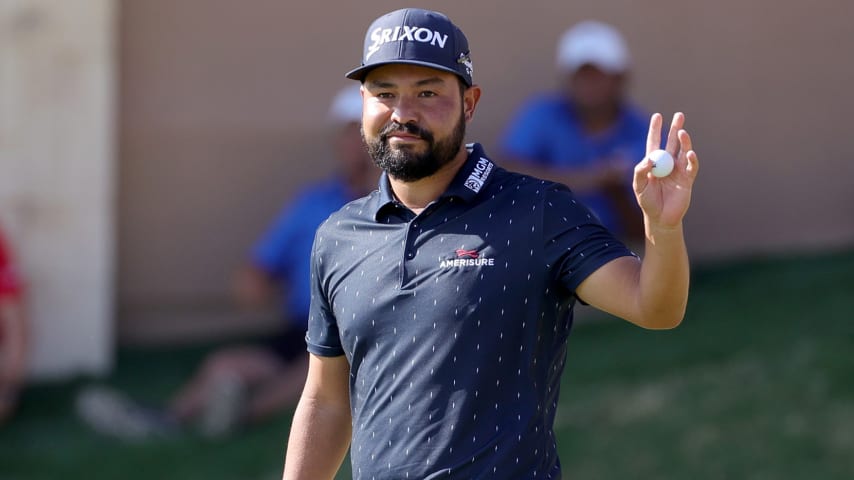
For J.J. Spaun, it was a no-brainer.
He’d just won the 2020 Travelers Championship Challenge at 15 ½ when his delicate wedge landed closest to the hole on that floating red umbrella 85 yards out in the pond beside the 15th green at TPC River Highlands. And Spaun knew exactly what he would do with the $10,000 prize.
He gave it to the JDRF, which is dedicated to finding a cure for Type 1 diabetes.
The donation was particularly important to him since Spaun had been diagnosed with diabetes in 2018 after an unexplained weight loss sent him to the doctor. At the time, he was diagnosed as Type 2, but he would find out after further tests in February of 2021 that he actually had Type 1, late onset.
A day after the charity competition, Spaun was in the player dining room when Andy Bessette, the EVP and Chief Administrative Officer for Travelers, came over and introduced himself. He told Spaun that his son Chris, who is now in medical school, had been diagnosed as Type 1 before heading off to college.
“He gave me like a big hug and was like, thank you for donating,” Spaun remembers. “That was so awesome because his son is a diabetic as well. And he and his wife, they donate a lot of money to this foundation trying to give people the resources to find cures and find ways to battle this disease.”
Bessette also told Spaun that he and his wife Cherrie were going to match Spaun’s donation.
“It meant the world to me,” Bessette says. “J.J.’s a nice young man and I was very impressed. We had more of a conversation. And then I said to him, J.J., if I can ever help you let me know.”
Bessette got that chance earlier this year at THE PLAYERS. He was sitting in a golf cart with Harold Varner III waiting to film some promos for the Travelers Championship, when the amiable pro from North Carolina got a disheartening text from Spaun.
“I said, well, what’s up, what’s wrong,” Bessette recalls. Varner told him that Spaun wasn’t feeling great and having some issues managing his Type 1 diabetes.
“I said, Harold, you tell him to call me. So, Harold texts and he showed it to me: Call Andy. He might be able to help you. So, I love Harold to death because you know what a big heart Harold Varner has. … And he connects me back with J.J.”
A few days later, Spaun reached out to Bessette, who set up a call with Aaron Kowalski, the president and CEO of JDRF, who is also a Type I diabetic. Kowalski told Spaun about a new inhalable insulin that is absorbed quickly and could be used, if necessary, on the course, rather than an injection. While they were talking, he also texted a doctor in Los Angeles who works with elite athletes on how to handle their blood sugar levels as a way to introduce her to Spaun.
“I'm learning all these new things through Andy and his connections,” Spaun says. “So, it's been great. Definitely something that I didn't think would happen for me, but that's the beauty of golf.
“You kind of meet all these people and next thing you're being helped out in an extraordinary way.”
Spaun is basically a self-taught golfer, and he’s taken a similar approach with researching and learning to manage his diabetes. Having the counsel of people like Bessette and Kowalski helps, and while Spaun is the first to admit he doesn’t have it 100 percent figured out, some weeks everything comes together.
Take the Valero Texas Open, for example, which was played about two weeks after that conference call. The 31-year-old was rock steady as he won his first PGA TOUR event, beating Matt Jones and Matt Kuchar by two strokes at the Valero Texas Open to earn his first Masters invitation.
“I was crying,” Bessette recalls.
On the golf course, Spaun wears a Libre blood sugar monitor that he checks with his smart phone every 30 minutes or so. “It’s part of my golf bag now,” he says. If the number is too high, he can have blurry vision and fatigue; when it gets low, he’ll feel lightheaded and shaky and reaches for something with sugar or carbs to eat.
Spaun is back up to a healthy weight of 175 after losing more than 50 pounds during the first three years he lived with diabetes. He’s worked hard to get his strength back and together with instructor Andy Patnou has found the “magic move” in his swing from when he played his best golf.
“He kind of gives me the recipe and I kind of bake the cake my own way,” Spaun says.
Bessette knows what it’s like to play sports at the highest level. He made the 1980 U.S. Olympic Team as a hammer thrower, although he did not get to compete in Moscow due to the American boycott. His experience as an athlete makes him really appreciate what Spaun has accomplished while dealing with Type I diabetes.
“I don't know that I could have done it,” Bessette says. “I don't think I'm that tough. It's just amazing to me. That's why I love J.J. I'm going to help him as much as I can. I so respect what he goes through, not just the struggle of being a world-class athlete and being competitive on the PGA TOUR, but just what he's dealing with on all fronts of his life. He's young man, he's got a young family and that has its own set of challenges, too.”
Since his victory at the Valero Texas Open, Spaun said he has been contacted by diabetics around the world who tell him how much they appreciate him sharing his story.
“They have made me feel like the biggest winner of all because they are saying that I was like a hero to them or inspiring to them or a great ambassador of what this disease does to them,” he says.
And the communication works both ways. The unassuming Spaun made it a point to go over and talk with a young girl in his gallery at the Sanderson Farms Championship last fall because she was wearing the same glucose monitor that he does. He signed a glove for her and told her not to let her diabetes hold her back.
“She was probably 10, 11 or 12,” he recalls. “… And I was like, hey, I have one of those too and I showed her the one on my arm. She like got super excited and smiled. After the round they came up and her dad just said thanks for doing that -- to see someone that is at your level, dealing with the same things she's dealing with kind of inspires her. …
“And that just made me feel good, too. I think I shot like 80 that day, but after I did that, after I met her, it was just like, there's so many more things in the world going on that like don't even matter other than golf. I’ve been dealing with this for four years almost, and there’s kids that have been dealing with this since birth.
“So, it’s tough to see, especially on young kids. That’s why I donated to the JDRF, as well.”
