


All-time wins leader Jason Gore recalls seven Korn Ferry Tour titles
11 Min Read
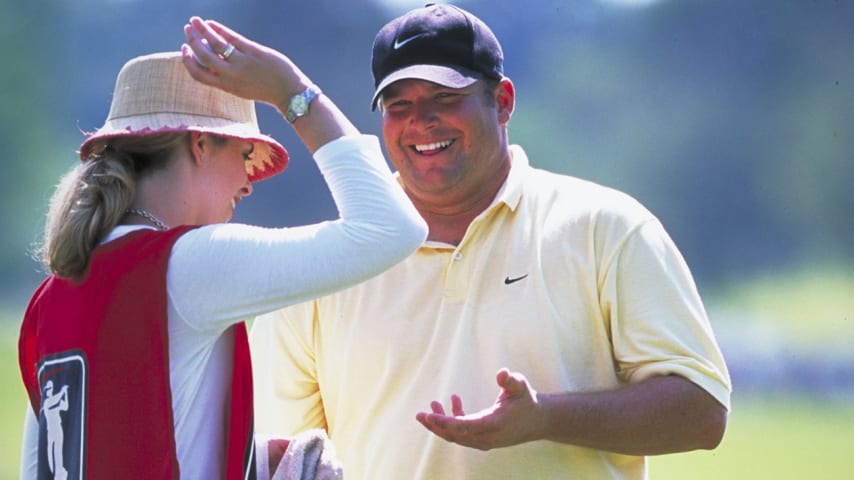
UNITED STATES - APRIL 13: Jason Gore (Photo by Stan Badz/PGA)
The affable Jason Gore is the winningest golfer in Korn Ferry Tour history, having earned seven titles in his career.
His accomplishments on the golf course notwithstanding, Gore has parlayed his personable and relatable attitude into first a successful insurance business, and, as of mid-2019, the first player relations director for the USGA.
The final of Gore’s seven Korn Ferry Tour wins came at the 2010 Miccosukee Championship.
While he still plays, he enjoys leaving tournaments on Wednesdays these days (instead of missing the cut on Friday, he jokes) and has had a wonderful experience taking his family from California to New Jersey to work out of the USGA’s headquarters.
In the midst of the 10-year anniversary of his seventh and final Korn Ferry Tour victory, Gore reflected on each of his wins and the magical 2005 season.
Buckle up – it’s story time with Jason Gore.
2000
Gore captured the New Mexico Classic as a 26-year-old. He won by three strokes over Mike Grob.
I remember I was traveling with Pat Perez that year, and he had won earlier that year and I just got so happy for him, but I was also so jealous, which was a good thing.
It was cold and windy and I think I stayed in a Motel 6 and I didn’t bring any sweaters; it was my 17th week in a row or something – I was beat-up. But I was a kid. It didn’t matter … you don’t really know you’re tired until someone says, ‘Gosh, aren’t you tired?’
I remember having to do laundry every night and washing the same one long-sleeve shirt I had. I wasn’t smart enough to go to the pro shop and buy a shirt. It was just an amazing week, though.
I hit it great. I drove it great. I remember hitting some great iron shots and rolling in a bunch of short putts. I remember playing with Eric Johnson and he said, ‘When I grow up, I want to putt like you.’ But I just thought it was about time I was putting the way I should. It taught me so much. I remember playing the way I thought I should be playing.
I swore when I was that age I would never talk like, ‘Back in my day…’ I just hated that, but we weren’t supposed to be good back then. It was always guys in their mid-30s (who played well). Your prime is different now than it was then.
I remember Kirk Triplett, when we came out in my rookie orientation and he’s probably 15 years older than me. He goes, ‘Welcome to the PGA TOUR, where you’re playing against the best players in the world on their home golf courses.’ He didn’t mean any harm by it, but that was the deal back then. You’re playing against a bunch of late-30s guys who have been there, and I hadn’t been.
Now if you’re 26 and you haven’t done it, you’re done. The age bracket for your prime is so different now, and we weren’t supposed to be great when we were 23-28 years old. You’re supposed to take your lumps and do your thing and learn. Now these kids are coming out and they’re experienced with better training. I learned that week that I could put that (win) in my tool belt and still try to get better.
2002
Two years after his first win, Gore won twice in a row. He first captured the Oregon Classic by three shots over five players, and the next week he won the Albertsons Boise Open by two. With those two wins, he earned a PGA TOUR card for the second time.
A guy from Whisper Rock (private golf course in Arizona) had worked for Aaron Baddeley and he came up to me in Wichita and asked if I needed a caddie, and I said I didn’t. But Dennis Blake, who was the putter rep for Odyssey, came up to me and said this guy was good. He knew him from Phoenix. I decided to try it. He was super timid the first few weeks, and then he came up to me and said, ‘You need to work on your wedges.’ And I said, ‘Excuse me?’ So he went to buy these soccer cones and we went and started working on wedges. I never remember doing this before we did, and we’d go out there and work on wedges. I never hit a driver that week (in Oregon); we just worked on wedges. I snap-hooked one on the second hole Thursday and I had like 93 yards over a tree, and I looked over at my caddie and said, ‘I’ve hit this shot like 500 times this week,’ and he goes, ‘Yup.’ And I hit it to a foot, made birdie, and I just started going. Every wedge I had, I had this upmost confidence that I was going to stuff it.
The same thing happened the next week. Anytime I teed off late in the afternoon, I’d meet him at like 10 a.m. and I’d just hit wedges for 45 minutes, and then go have lunch, and then warm up and go play. My wedge game got so good.
Boise was playing hard and fast when it was in September. I told (my caddie), ‘There is no reason why we should win here.’ It gave me no advantage. He goes, ‘This golf course is perfect for you.’ I just tore that place apart with irons. I had this 2-iron that was a butter knife back before hybrids … I’d hit it about eight feet off the ground and chase it down the fairway, wedge it close, and have a putt for birdie.
2005 – U.S. Open and The Streak
Looking back on golf’s history in the early 2000s, one name very obviously stands out: Tiger Woods. But Woods’ childhood competitor (Gore and Woods played in a handful of junior events together in California) stole the show in 2005.
After playing in the final group Sunday at the U.S. Open, Gore returned to the Korn Ferry Tour and followed a T10 with three consecutive titles (National Mining Association Pete Dye Classic by one; Scholarship America Showdown by four over eventual FedExCup champion Bill Haas; Cox Classic in a playoff after shooting a second-round 59).
After earning a battlefield promotion to the PGA TOUR, he would go on to win the 84 Lumber Classic in September.
All of his wins came after the U.S. Open at Pinehurst. Gore shot a closing 84 and tumbled down the leaderboard to T49, but he says that Sunday was the key to all of his success in the months that followed.
That year was a lot of fun. It was a lot of fun.
In 2003 and 2004, I struggled – just confidence-wise. I got beat up on TOUR a little bit – until I won the California State Open in 2004. I went to the Scotty Cameron studio and I got this putter called a BBC; it was a copper putter like what I grew up with. It made this DING noise. It was obnoxious. It was beautiful … this bright-copper color. But I thought, ‘Geez Louise, you can’t putt with this thing in sunlight.’ I started with it and I liked it. It had the sound, the look, it freed me up with no lines or anything, and I just putted great with it.
Things started clicking. I made (another) equipment change. I switched balls right around the U.S. Open qualifying. I went to East Lake; it got rained out and I almost didn’t go back. My caddie said I had to go back. I was two or three off the number, but I went back and finished the next day. I birdied two of my last three holes and got in. But, I almost didn’t go.
I went to Pinehurst and switched drivers – I had something I stole from the TaylorMade van and they probably didn’t know I had it, because I was under a Nike contract at the time. I started bombing it. I just wanted to hit bombs. I played decently the first two rounds at the U.S. Open, I made everything on the greens and I got into contention … and the rest is history.
I played terrible the last round. I tried to win the U.S. Open when I should have just tried to continue to play golf and play properly around Pinehurst. I didn’t do the right thing, but I learned a valuable lesson. No matter where or what I would do in my career in golf, I would never, ever see anything like that again. I could always say, ‘You know what, I’ve been there.’ I saw the worst, so I was like, ‘Alright, let’s go have some fun.’
I took Sunday at Pinehurst as a learning experience.
I could have said, ‘Wow, I just ruined a great opportunity,’ but I wanted to learn from it. The next week when I played on the Korn Ferry Tour, I finished (T10) and I didn’t even feel like I played that well. Any time after a U.S. Open, every golf course seems easy.
Those weeks (when I won), you have so much confidence. It didn’t really matter how I was playing; I just knew whoever was going to win had to go through me. It was one of those things were I was like, ‘Yeah, I’m better than you are.’ I don’t know if I was, but darn it, I thought I was.
The 59 I shot with pink eye.
I had pink eye that week and that’s why I was wearing the sunglasses. I was in Green Bay, and all of a sudden my eye started itching. I had no idea what was going on. I thought I had an allergic reaction. I went to a supermarket where they had a pharmacy and the guy says, ‘Yeah, you have pink eye.’ And I didn’t know what that was. They gave me some ointment, and the first round I couldn’t see; I was literally playing with one eye. Thursday, I was getting better, but Friday, my coach at the time, I was hitting it so bad on Friday morning that I said, ‘Dude, leave me alone. Let me just miss this cut and I’ll win next week.’ I played high school golf with this guy, and I just said, ‘Get away from me.’
At this point, I had won two in a row and every camera on the Korn Ferry Tour was on me and I had never been through anything like this. I wanted to decompress and just go in a corner for a little bit. Next thing you know, I’m standing over a 20-footer to shoot 59 and I buried it. That’s just the way things went.
2010 – The Finale
After Gore’s lone PGA TOUR win in the fall of 2005, he went back-and-forth on the Korn Ferry Tour and PGA TOUR for the next five years. He captured his final Korn Ferry Tour event in October 2010 at the Miccosukee Championship, four clear of the field.
At that point, I wanted to get back on a streak. I was decent for a couple years after 2005, but a lot of stuff was thrown on my plate that I wasn’t quite ready for. I like my privacy and I’m totally fine being alone. I love my family and I love being out of the spotlight, and that probably hurt my career a little bit. I don’t know, but it was an odd time for me to be thrown into that spotlight. I cowered away from it, maybe.
I love golf, I love being a part of it and I love the competition, but I think when I got back there and I won by a bunch (in 2010), I realized I wanted to be a competitor again. It got the juices flowing. A few times I got my TOUR card back again, but I fought injuries. Right after 2010, I had shoulder surgery, some back injuries … and Father Time is undefeated. That was really it.
Never in my wildest dreams did I think that was going to be my last win. You never want to say it is, but it is.
Doing what I do now … I see these guys and I think I miss competing, then I walk out onto the range on Tuesday and see them grinding and beating themselves up and I’m like, ‘No, I’m good! I’m fine!’ I go home two days earlier than I used to and I get a paycheck, so I’m good. I love everybody out there; I miss all my friends, but I still get to see them. I miss the competition, but I don’t miss the grind.