
Local farm fosters reusable food cycle at Sentry Tournament of Champions
4 Min Read
Escrito por Helen Ross
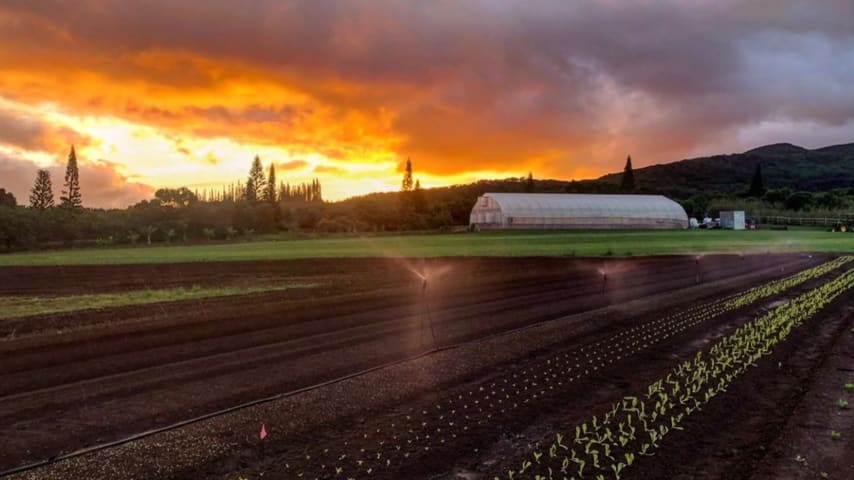
Maui’s Hua Momona Farm is just a short 10-minute drive up the mountain above the Plantation Course at Kapalua, which hosts this week’s Sentry Tournament of Champions.
“It’s literally in our backyard,” said Amanda Wolf, the event’s tournament manager.
The organic farm set on 25 acres already supplied vegetables for the Plantation House restaurant in the clubhouse at Kapalua – and this week for many of the hospitality areas on the property. So, it only made sense to take the relationship one step further.
We’re talking compost, folks.
From early-morning kitchen prep work to evening clean-up, the tournament’s food waste is being collected in color-coded, 60-gallon trash cans and taken to Hua Momona daily. There it’s tilled into the soil to make what becomes fertilizer for new crops of greens and vegetables like turnips, zucchini, radishes, beets, onions, tomatoes and scallions.
“So, by this time next year, conceivably the vegetables and produce that they eat in the Plantation House and at some of the concession stands could come from the compost, the food waste, from the tournament this year,” Wolf said.
That cycle of life, so to speak, is in concert with the Hawaiian culture, which counts the land, or ’aina, and the sustenance it provides, as prime among the island’s resources. Wolf, who has lived in Hawaii for nearly six years, understands how important sustainability is to the state.
“And I think that comes very full circle for us working in the industry because we play on (the land),” she said. “We need that in order to have golf, right? We need the land. So, it's very interesting and we need to take care of it, respect it, so that we can participate in our industry.”
For the staff at the Plantation House and in the concession areas, separating the food waste is an extra step in what can be a complicated process of preparing meals like opakapaka (Hawaiian pink snapper) in a lemon caper beurre blanc -- accompanied by Hua Momona greens and vegetables, of course.
But Noah Yamada, general manager of the Plantation House, knows working with their neighbors at the farm the right thing to do. And it could carry on past Sunday when the final putt drops at the PGA TOUR’s first designated event of 2023.
“It's a great way for us to give back to them because when you compost the soil, it just gets richer and richer,” Yamada said. “They're already doing that up there with their waste. But to turn around and do it with ours and then send it back up to them, which is only a mile up the road, it just makes sense.”
The compost partnership isn’t the only sustainability project that has been implemented at the Sentry Tournament of Champions, either. There are two hydration stations on the property, sponsored by Maui Health, and fans are encouraged to bring their own water bottles to fill.
In addition, reef-safe sunscreen will be dispensed at four different stations at the tournament. All food vendors will follow Hawaii state guidelines that prohibit Styrofoam and mandate the use of biodegradable containers, as well.
Wolf hopes the emphasis on sustainability lets the fans know that Sentry and the PGA TOUR haven’t come to Maui this week just to play golf and leave.
“We’re really committed to this island, the culture and not leaving such a footprint,” she said. “We're trying to do the right thing. We're playing golf, we're hosting the tournament, but we also are very thoughtful in what we're doing here, and we want to make the right impact.
“The island and the land are very important to Hawaii, but it's also important to us. So, if we instill that in one person, hopefully they can instill it in another, and we can protect our land and protect this beautiful place for many years to come.”
Hua Momona, on the other hand, is a relative newcomer to Maui.
The farm began producing microgreens in its 4,000-square foot greenhouse in 2019. When the pandemic hit and restaurants closed, the business pivoted and concentrated on field crops and weekly contactless delivery of boxes of vegetables. In addition, the farm began to donate vegetables to homeless shelters and other organizations helping families in distress.
This year, the farm started the Hua Momona Foundation to continue to support people experiencing food insecurity, as well as introduce young people to agriculture and potential job opportunities in the industry. In all, over 20 tons of food have been donated since 2020.
Tina Carranza, president and chief operating officer of Hua Monoma, said it will likely be several months before the farmers harvest any vegetables or greens that have been enriched by the compost fed by the tournament’s food waste. Wolf hopes some will be ready in May when the Sentry Tournament of Champions makes its charity announcement.
“it’s a really exciting cycle to be part of,” Carranza said. “The fact that we can reuse waste to create something new and of value is pretty amazing.”