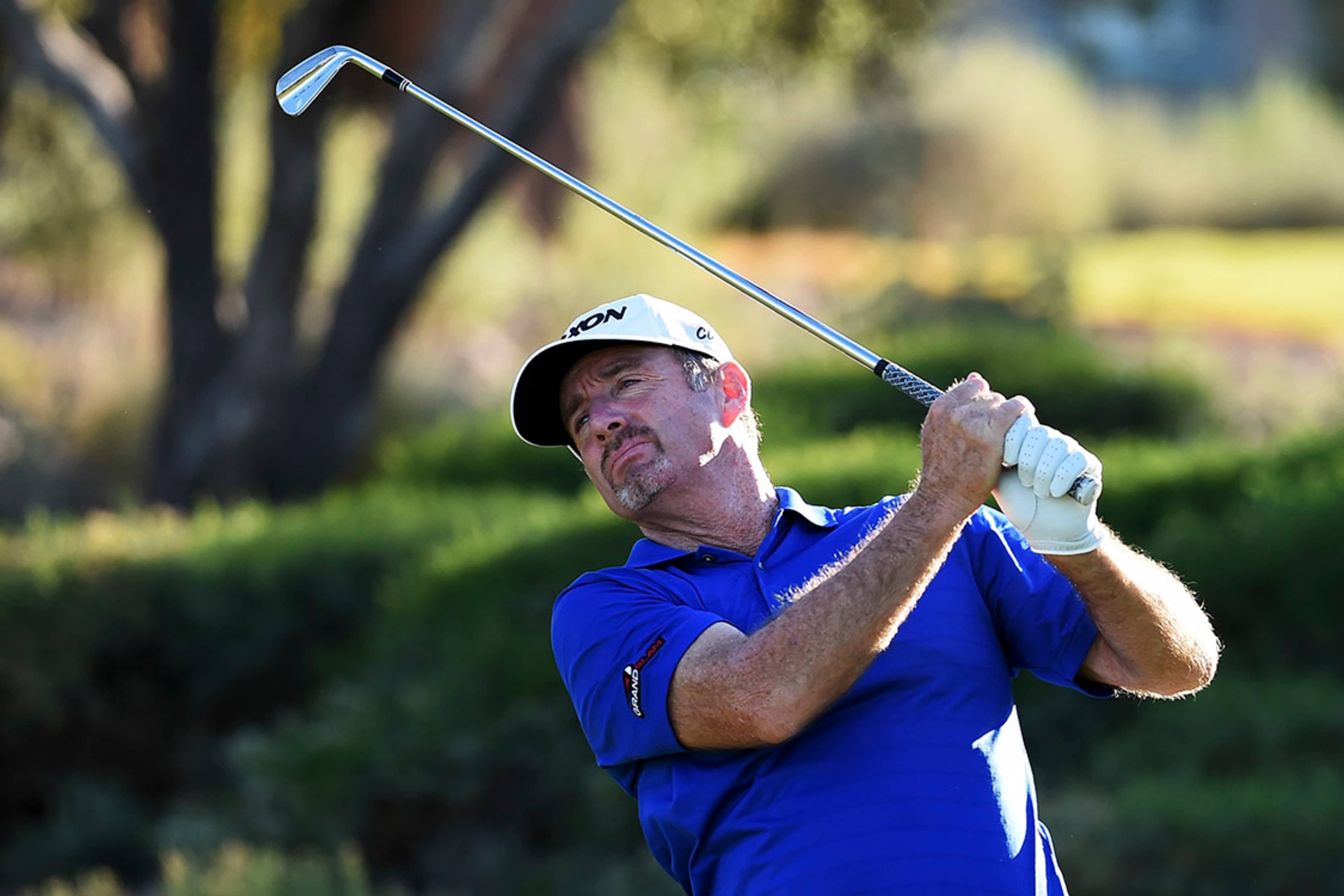
Nick Lindheim's unusual path to the TOUR
15 Min Read

Nick Lindheim took up golf late, is self-taught and changes caddies often -- but that hasn't stopped him from reaching the PGA TOUR
Nick Lindheim took up golf late, is self-taught and changes caddies often -- but that hasn't stopped him from reaching the PGA TOUR
Being Nick Lindheim’s caddie might be the least secure job in golf.
Last season, he played in 21 tournaments on the Web.com Tour. He used eight different caddies.
It’s not that Lindheim was dissatisfied with their performances; the revolving caddie door was mostly a cost-effective move, one that allowed him to reduce his expenses and the stress on his young family.
Most weeks, he simply opted to pick up a local caddie at the club hosting the event. Meanwhile, he calculated his own yardages, just like he did as a teenager when he first learned to play the game.
He saved money but there were weeks that left him exhausted. Consider the Web.com event in Lehi, Utah. The altitude -- 4,500 feet above sea level – and elevation changes complicated his computations, as well as his stamina. “That was pretty hard,” Lindheim acknowledges. “But it kept me in the game.”
It certainly did. Lindheim won the Utah Championship presented by Zions Bank in July on the way to earning his PGA TOUR card for the 2016-17 season.
Two months later, he nearly won for a second time, making a four-man playoff at the DAP Championship before being eliminated on the first sudden-death hole with a par.
Yes, he had a different caddie that week.
Those unconventional weekly partnerships were just one aspect of Lindheim’s rather unique rise to the PGA TOUR, though.
The oldest rookie on TOUR this year -- he turns 32 next week -- didn’t play junior golf. He didn’t go to college. Until recently, he didn’t have an agent. He still doesn’t have an equipment sponsor. And he doesn’t have a swing coach.
Lindheim taught himself the game, then persevered through seven years on the mini-tours before reaching the relative security of the Web.com Tour in 2014.
Once there, the progress has been steady. “I always told my wife, if I can get at least three years on the Web.com Tour, I’m pretty confident I can get my TOUR card,” Lindheim says.
And he did, finishing 14th on the Web.com Tour Priority List in 2016. Three weeks ago, Lindheim’s rookie year on TOUR began with his first start at the Safeway Classic.
The cap he wore that week in Napa, California, was devoid of the customary sponsored logos. Lindheim had a solid black stand bag, not a staff bag, although his name was embroidered on the back pocket.
And while his caddie was in his third week of employment, the two would part ways at the end of the week. No surprise there.
Lindheim knows he doesn’t exactly fit the mold of a TOUR pro. But at the same time, he knows he belongs.
“The way I kind of think of it is we were all born, we were all given life, and there’s nobody that’s better than anybody at the end of the day,” says Lindheim, who is in the field this week at the Shriners Hospitals for Children Open. “Somebody may have more money. Somebody may have more wins. Somebody may have a better golf swing.
“But at the end of the day, I just feel so lucky to be playing golf for a living and to be amongst the guys that so many people look up to.”
There was a time when Lindheim probably would have pictured himself on the mound during the World Series rather than standing over an 18-footer for birdie to win the Masters.
As a kid growing up in Mission Viejo, California, Lindheim played soccer and baseball – that is, when you didn’t find him and his buddies riding skateboards. He came by his athletic talents honestly – his father made the Olympic trials as a swimmer, his mom ran track and his older sister Bryttani played softball at Florida State.
“We had a pretty good gene pool,” he shrugs.
Being a pitcher eventually took its toll. By the time he got to El Toro High, Lindheim’s right arm was showing the wear and tear of competition.
“It was like a slow progression into my arm, basically not even being able to lift my arm at one point,” he says. “I was always told not to throw curve balls. It’s bad for your elbow, bad for your shoulder.”
But Lindheim did. He liked striking out batters, and he soon realized kids had trouble hitting a curve ball. So he kept throwing it.
“Most kids were scared of getting hit by the ball,” he says, “so you’d start it out kind of towards them and it would curve right back into the strike zone. It was fun, but little did I know and being young and not wanting to listen to anybody like most teenagers, I ended up completely wrecking my arm.”
Luckily for Lindheim, he had friends who played golf, and one suggested he try out for the team. He was a sophomore at high school, and at that point, had only visited the range a few times with his father. He was intrigued but, of course, was also out of his element. Despite his athletic background, Lindheim wasn’t sure he had what it took to play golf.
“I got the butterflies and got scared,” Lindheim said.
So he walked to the other side of the range, as far away from his buddies as he could go. Eventually, the golf coach came over and watched the teenager hit balls. Lindheim thinks his sister’s success had a lot to do with the coach taking a chance on him.
“I think he knew that I was athletic and I could progress,” Lindheim says. “I've always had a pretty natural swing. I could swing it hard. I just didn't necessarily know where it was going.”
The first time Lindheim played nine holes in qualifying, he didn’t break 57. His scoring average was just a percentage point over 39 by the end of that sophomore year, though. “I progressed into one of the better players on the team,” he recalls.
Despite shifting his focus from baseball to golf at that late age, Lindheim didn’t lean on an instructor to help refine his swing. While there are times he wishes he had a teacher to fall back on, he is essentially self-taught.
“I am very compulsive when I love something, so I mean, I did it all the time,” Lindheim says.
He worked in the cart barn and picking up balls on the range at several California country clubs for playing privileges after work. And Lindheim would often take his clubs and his dog Reebok, a bloodhound-Vizsla mix, to the field where he used to play soccer.
“She’d chase the rabbits and I’d hit ball after ball after ball,” he remembers.
Even as he progressed, Lindheim knew the odds were stacked against him. Plus, he loved hanging out with his buddies at the beach or skateboarding, which also fueled his competitive juices. He wasn’t on a “bad” path per se, but he didn’t any “structure.”
So once he decided college was out of the picture, Lindheim took what he acknowledges was a “risk” and decided to pursue golf as a career. He didn’t want to give lessons, though. He knew he wouldn’t be happy cooped up in a pro shop. He wanted to compete.
“This may sound a little different, but I've watched golf on TV even before I played golf, and I always thought, how hard could it be to put a ball in a hole and get paid millions of dollars,” Lindheim says.
“So when I first picked up golf, I wasn't very good, but I have always progressed really fast, and I've kind of been very fortunate to have steady forward progress. So as I got better it kept creeping in my mind.
“I always thought I could do it, but it's hard to think you can do it and then actually do it.”
Of course, it’s easier when someone believes in you.
Enter Gracie Heim. She had just finished law school at Stetson University and had moved back to Satellite Beach, Florida, where she was rooming with her brother’s good friend, Adam Wickwire, who was at the time a professional surfer.
“He was never home -- he was the best roommate ever,” Gracie says with a laugh. “And when he was home, he was playing golf with Nick.”
So it wasn’t a surprise their paths would cross. Nick didn’t know if it was love at first sight, but he says Gracie made him feel “alive.” That was a decade ago and they’ve essentially been together ever since. Married a few years ago, the couple has a 3-year-old daughter named Shyla.
“She’s an amazing, amazing woman,” says Lindheim, who proposed on the same stretch of beach where his wife’s friends had always gathered. “Anybody who meets her for the first time is always – I don’t know the proper word to say here – but she just makes you feel good.
“She laughs at all of your jokes, which is always a good thing. But she’s just very kind-hearted and comes from a great family.”
Gracie – who has kept her last name for business purposes (Yes, her husband has suggested more than once she “just add a Lind”) is the oldest of four raised in the kind of close-knit clan her husband didn’t have growing up. She played volleyball at Florida Atlantic, so she understands an athlete’s psyche and competitive nature.
But the two couldn’t have been more different in their approach to their respective games.
“I am super-structured, by the book,” Gracie says. “My coach said I was super-coachable. Nick is like a feel player. We are very different in that sense. I had never met anyone like that.
“But I had a feeling. I knew he could be a pro golfer. I just knew it.”
Her job as a lawyer specializing in estate planning, wills, trusts and corporate law offered the couple some stability. Lindheim says his wife is the “heart and soul” of their family, maintaining a sense of normalcy while he was on the road.
“My wife is a huge influence in where I'm at right now because we, myself and her, put kind of all our eggs into one basket as far as her believing in me and doing it as a profession,” he says. “She's an attorney, so we've always kind of had a nice backup plan, but I don't know many people that have a stay-at-home dad, so I wanted to be the sole provider for our family, and I thought I could do it -- and so far the last three, four years we've been doing all right.”
A group of local businessmen offered Lindheim some financial support early in his career. He didn’t like asking for money but he knew it would allow him to pursue something he loved. The couple even held a fundraiser or two.
And for the better part of the next seven years, Lindheim chased his dream on the eGolf Tour and the Hooters Tour and anywhere else he could find a place to play.
His biggest paycheck during those times? It doesn’t take Lindheim long to remember – it was $11,500 when he won the Ocala Open.
“At the time, it was huge,” Lindheim says. “That was such a big check and it’s still a nice chunk of change. But prior to that, you make $500 and you’re very, very happy.”
Lindheim found even more success on the Web.com Tour, making more than $425,000 in three seasons on the way to earning his TOUR card. But even as recently as last year, there was a crisis of confidence. He was off to a slow start and wasn’t making any putts.
Meanwhile, he had missed Easter with his family. And he missed Shyla’s birthday.
So he called home.
“What are we doing here?” he asked his wife.
Replied Gracie: “You’ve got full status. We’ve got enough money to last through the end of the season. Why don’t you just finish, and we’ll reconsider?”
Something would soon change everything,
“He won,” says Gracie. The very next week, in fact.
Lindheim’s background partially explains why he goes through caddies so frequently. He didn’t grow up in a country club setting. He carried his own bag when he played.
And there were plenty of times when money was tight.
Caddies on TOUR are normally paid a weekly salary and a percentage of the money that the pro earns at the tournament. So having a no-strings-attached, one-week relationship with a local caddie sometimes seemed like the way to go.
While it’s a financial decision, it also helps Lindheim mentally, he says. He admits he sometimes “gets out of my element or thought process” when he works with an established TOUR caddie.
Plus, having one less person depending on him for their livelihood alleviates some of the pressure.
“I have a family to provide for and I have to provide for another grown man,” Lindheim says about the situation. “It’s tough, and the Web.com Tour, if you’re in the top five on the money list, your caddie can get by for the year but other than that, it’s tough. …
“It took a lot of stress off me from the standpoint that I didn’t have to provide for anybody other than I’ll pay you a week or a daily rate and at the end of the week, if we play well, I’ll tip you as it goes.
“It worked out for me. I could play my game.”
A similar thought process entered into Lindheim’s decision not to hire an agent, who gets a percentage of the deals he negotiates, until after he made his TOUR debut at the Safeway Open last month. His wife, after all, is an attorney.
“And we’ve had some very long, hard conversations and thoughts of what best suits me,” Lindheim says. “I’ve worked my butt off to get where I am and it’s tough. It’s tough giving away the stuff you’ve worked really hard for.
“They can help you, and I don’t want to take anything away from them … but I’ve always felt that I’ve gotten this far on my own, why do I need any help.”
Lindheim recently hired Sterling Sports to represent him, though. One of the first priorities is to negotiate an equipment deal.
“We're playing for a lot of money out here on the golf course, and I've been told 100 times from different people, play the clubs that got you out here, this, that and the other, and I agree 100 percent,” Lindheim explains. “But by the same token, it's like, who do I go to if I need some help with my irons, or who do I go to if I need a new grip?”
Lindheim does have a contract to play TaylorMade woods. His ball and shoes are Titleist “so I can kind of bounce off of them for anything I need with that,” he said.
“But when it comes to my irons and like a bag and a hat, I'm wearing a True Temper shaft company hat that's a great hat and they're a great company, but they're not paying me six figures like most of these guys are getting from the hat they're wearing.” Lindheim adds.
“So it’s a little different. I'm probably the only guy out here without a staff deal at this point."
Whether he has a deal or not, Lindheim – who calls getting his actual PGA TOUR card his “pinch-me moment” -- is doing something right.
He’s made the cut in his first two starts as a TOUR member, although with differing results. Lindheim was 70th at the Safeway Classic and tied for 23rd at last week Sanderson Farms Championship. He also made the cut in the 2014 U.S. Open at Pinehurst in his only other TOUR start.
“The second hole we played (at Safeway), I hit an 8-iron in there to about 15 feet and made the putt and there was a pretty good crowd and they all went crazy,” Lindheim recalls with a broad smile. “… It was electric, like they say.
“It just sent chills up the spine, and that was definitely like, wow, I’m playing the PGA TOUR. It’s pretty awesome.”
Lindheim, who averages just over 300 yards off the tee, says he’s always been drawn to players such as Seve Ballesteros and Phil Mickelson, who are known for their scrambling ability and short games.
“It’s really fun to watch (Phil) play because it’s not always perfect – but there is no perfect,” Lindheim says. “I try to relate my game to guys that kind of have the same game because I may hit it all over. But at the end of the day it’s what did you shoot?”
Mickelson made his 2016-17 season debut in Napa, as did Lindheim. He saw the veteran there and said hello, “and he gave me the Phil Mickelson nod with the smile and stuff.
“I’m sure one day I’ll say hello and shake his hand and introduce myself, but I don’t really get star-struck. I know that those guys always have got something going on just like the rest of us and I don’t want to bother anybody. We’re all out here to work.”
Gracie, for one, is hardly surprised by her husband’s success.
“When he hones in on something, I won’t say he’s obsessed but he’s definitely driven,” she says. “… I know there are sacrifices but that makes him a better person because he’s fulfilled,
“He has more self-confidence and self-worth the last few years. This has been great for him.”